New York Times, City Room
September 21, 2009
Jennifer Lee
City oversight over horse-drawn carriages has improved since an audit two years ago by the city comptroller’s office, but the two agencies that oversee the business have acted too slowly in putting reforms into effect, a new report has found.
The new report, from the office of Comptroller William C. Thompson Jr., is critical of the two agencies: the Department of Health and Mental Hygiene, which is responsible for the well-being of the animals, and the Department of Consumer Affairs, which licenses the horses, drivers, carriages and stables.
In the new assessment, the comptroller’s office found that the two departments implemented 7 of the 11 recommendations made in the 2007 audit, including a key one that to create an advisory board first proposed two decades earlier.
However, it found that the Health Department had acting too slowly on the recommendations made by the advisory board and for failing to find new ways, other than tagging, to identify horses. Effective identification is considered important in keeping track of the horses and ensuring their safety.
The horse-drawn carriage business, while modest in its size, has generated fervent protests. The Coalition to Ban Horse-Drawn Carriages wants the business to be outlawed in New York City, as it has been in other metropolitan areas around the world. A 2008 documentary, “Blinders,” which some people criticized as being selective in its use of evidence, documented some of the problems in the business.
Fueling their arguments is the continual drumbeat of accidents, including one over the weekend, in which a horse-drawn carriage and a taxi collided on the Upper East Side when the cabdriver reportedly suffered a seizure.
The new report did find signs of progress since the last audit. For well over a year, for example, the Department of Consumer Affairs has completed the required inspections of every carriage on schedule. There are currently about 200 licensed horses, 280 licensed drivers and 70 licensed carriages. Nearly all of them operate in or around Central Park.
One of the ongoing issues is how a method other than tag numbers can be used to identify working horses. The 2007 audit found a startling inconsistency: the paperwork for at least 57 carriage horses described different animals from year to year, including changes in color and sex, while the license numbers did not change. The advisory board recommended the use of microchips, a practice that has been adopted in other cities.
However, the Health Department responded that the main problem is a requirement in the city’s administrative code that horses to be branded on their hooves. Until that is changed, the department said, the city cannot being requiring the use of microchips to identify the horses.
The Health Department said on Monday that its commissioner, Dr. Thomas A. Farley, was “following up on the work of his predecessor,” Dr. Thomas R. Frieden, and that Dr. Farley had “received the recommendations of the Rental Horse Licensing and Protection Advisory Board and is reviewing” them.
Carolyn Daly, a spokeswoman for the Horse and Carriage Association of New York, said, “The industry has always been committed to implementing stronger measures to ensure the safety of our drivers, horses and passengers. We appreciate the Mayor’s office intensive efforts over the last two years to review all operations and issues and look forward to real improvements being implemented soon.
However, animal-rights activists said nothing short of a ban would be sufficient.
Dan Mathews, a senior vice president at People for the Ethical Treatment of Animals, which is part of the coalition to ban the carriages, said in a statement:
"The comptroller’s audit shows that the city is incapable of even addressing the ongoing problems with the carriage horse trade, much less enforce the weak regulations that exist. After 25 years the city is still trying to figure out how to identify horses properly so that drivers don’t illegally double-shift them. They don’t even touch on other issues, such as compelling drivers to keep the horses in stables when freezing weather or violent storms are forecast, or to document the many accidents involving horses that don’t make news. We hope this report convinces the city to go the way of Paris, London, Toronto and Beijing and conclude that big city traffic and easily spooked large animals don’t mix. The horse-drawn carriages need to be banned outright."
Tuesday, September 22, 2009


Friday, September 4, 2009
FAQs for Animal Adoption
FAQs of Pet Adoption...
This Fall there are an impressive amount of adoption events as we near New York Week for the Animals, Halloween, and more holidays. With that in mind, there are some things that we should remember as we look to save a life and adopt our new best friend:
What is required to complete adoption of my new furry family member?
Most shelters and rescues will require the following:
Proof of identification Reference(s) Payment - adoption fees vary and are essential in helping shelters cover care and medical costs. Proof of pet allowance in apartment buildings may be required as well.
I have allergies and can only tolerate specific types of dogs / cats. How do I still adopt?
The best solution to situations of allergies is to speak with a medical doctor as well as a veterinarian to find out exactly the types of animals you can and can’t be around. There are myriad pure breed rescue groups with the breed of dog that will not trigger your allergies, but you must be patient in searching for the right animal in your area rescue group that fits with your needs. If you are allergic to all cats and dogs, you may be able to take certain types of allergy medications that will allow you to live with a new pet without issue. Consult a doctor and a veterinarian to be sure.
How do I know what organization to adopt from?
Just like with any business, there are certain standards that experienced and successful rescue groups and shelters abide by. Be sure the organization you are adopting from charges an adoption fee which covers vaccinations, spay/neuter surgery, and microchip for dogs (sometimes for cats too). You should speak with an individual that can be candid about the animals you’re interested in and also about the organization. Feel free to ask questions too, so that you feel assured of your decision and the animal you match with.
Does the city shelter euthanize animals?
Yes. New York City Animal Care and Control shelters are required by the City of New York to take in every animal that is brought in or relinquished to them. This includes exotic and farm animals, as well as all shapes and sizes of cats, dogs, and rabbits. Occasionally Animal Control officers will pick up stray animals, but they will not respond to calls about feral cats or requests to pick up stray dogs or cats. The Animal Care and Control shelters have too many animals than kennels, foster or adoptive homes, therefore, they must put animals to sleep in order to accommodate the flooding of animals they experience every day. It is a sad reality – but you can do your part by adopting, fostering, and encouraging others to do the same. Remember – ADOPTION IS THE ONLY OPTION!
What is the process?
A reputable, reliable rescue or shelter organization will have an adoption application and adoption fee, which allows them to screen people and ensure their animals are going into loving, safe homes – and will not fall into the wrong hands. The adoption application and the adoption usually do not take place on the same day, as adoption reps must read the applications and check references first before letting an animal out of their hands for good.
Why so many questions? I’d make a great pet parent!
You will probably be asked a lot of questions, but that is a good thing! All involved need to make sure the new home is a sure thing, not a whimsical thought that will change the day after Fluffy or Scruffy come home. Remember, you may be a pillar of your community, but not everyone is. Think of it as a job interview. Are you the right fit for Max or Maxine?
Some questions may include (in random order): (1) where do you work? what are your work hours?, (2) do you have screens in your windows?, (3) can you afford a standard vet visit, which can add up to hundreds of dollars?, (4) will you get pet insurance? are you interested in more information about pet insurance?, (5) what will you feed the animal?, (6) how many times a day will you walk the dog?, (6) will you or a walker walk the dog?, (7) do you have pets?, (8) do you have a spouse or roommate?.
Some agreements may include:
-no declawing of cats
-return of animal ONLY to adoption/rescue group; do not give to other shelter or organization.
The transaction of adoption holds no guarantees, but the steps along the way greatly increase the chances of a positive and forever rewarding experience. The better you understand the care with which a good rescue group places their animals and the importance of it, the better equipped you will be to bring a new companion animal into your home and your life.
Why do they have to visit my home?
A good organization will care where their rescued animals are going to live, so some may ask to do a home check. Don’t be offended! It’s only for their liability standards and peace of mind and for the safety of all the animals and the people who want to adopt them. While your home may be a great place for a dog and/or cat to live, another’s may not be, and the only way for the rescue group to know the difference is to ask a lot of questions and, often, see the home themselves.
Why such a laborious process? I want to bring Fido home today!
All great things are worth the wait. Same-day adoptions are rare and even frowned upon in the rescue community. Adopter and adoptee want to avoid the pitfalls of the “impulse buy”, which can result in a bad experience and a return of the animal – this takes up time and energy on everyone’s part and ultimately leads to a sad outcome for the animal. If a person is truly committed, they will follow the adoption process and wait until their new best friend is ready to come home.
I just got home and things aren’t going well. What do I do?
Just like with humans, animals require space and time to adjust to major life changes. Some shelter experiences are very harsh for animals, and they may express their confusion and apprehension in odd ways. It’s no one’s fault – and it’s completely normal. Give your new pet at least 48 hours to adjust fully before making a real assessment of how things are going.
The adoption rep should give you advice on animal care and provide a contact name, phone number/email address that you can use for questions or concerns.
What is fostering? How do I do it?
Fostering is one of the best ways you can help animals and those who work tirelessly for them. By giving a homeless animal a temporary place to live, you are committing to the care of the animal but understanding that the animal is still up for adoption and will be placed in their forever home at some point. The length of fostering varies depending on the needs of the animal and the rescue group, so be sure you know what will work for you and what you can commit to. While fostering, you can take pictures and give updates to the rescue group so they can post it on an animal adoption portal such as petfinder.com or adopt-a-pet.com. You may also be required to bring the animal to adoption events, so be sure to discuss that and all other details before you commit to fostering.
I just adopted my new pet, and I love her! But I want to continue to help. What can I do?
Congratulations. You’ve just made a huge difference in the lives of, not just your new furry family member, but of the people who rescue and care for homeless animals. Plus, by being another example of the rewards and virtues of pet adoption, you have helped the animals still awaiting homes by showing those around you how awesome adoption truly is.
Here’s what else you can do:
Send in your story. The organization you adopted from can post online or in a newsletter their happy endings which encourage more people to adopt and also keep everyone motivated in the mission to save animals’ lives.
Volunteer. If you like manual labor, get on over to a shelter, because they want YOU! Cat cages need cleaning, dogs need walking, and all the animals need fresh food and water multiple times a day. You can also write accounts and anecdotes about your favorite animals. The shelter can post them so potential adopters can learn a little more about the individual animals needing homes.
If you have special skills such as writing, marketing, fundraising, design, photography, event planning, etc., inquire about joining a committee that can utilize such skills.
Check out http://www.animalalliancenyc.org/ for lists of rescue groups, including pure bred dog and cat rescue groups, rabbit and reptile rescue groups, and bird rescue groups in the area.
See http://www.newyorktails.com/ for a COMPLETE list of Halloween pet events in New York City.
Sunday, August 23, 2009
Sadie, rescued pit bull of Rational Animal Pit Ambassador namesake needs home!
As many of you know, Sadie Blackstar is Rational Animal's pit bull ambassador. Well,  there is another Sadie who probably came from a similar background as our little Blackstar. A pit with somewhat distended glands under her belly, Sadie probably had puppies recently and was thrown away. She was rescued from the euthanasia list not the day of but the HOUR of what would have been her death. A couple I am friends with had seen her at the Brooklyn AC&C a few days prior and inquired with me last Saturday night. I was shocked, because I knew she was to be put down the next morning -- less than 12 hours from the time I learned they were interested in her. When I told them that she was to go down, they decided to foster her.

there is another Sadie who probably came from a similar background as our little Blackstar. A pit with somewhat distended glands under her belly, Sadie probably had puppies recently and was thrown away. She was rescued from the euthanasia list not the day of but the HOUR of what would have been her death. A couple I am friends with had seen her at the Brooklyn AC&C a few days prior and inquired with me last Saturday night. I was shocked, because I knew she was to be put down the next morning -- less than 12 hours from the time I learned they were interested in her. When I told them that she was to go down, they decided to foster her.Through United Action for Animals, I was able to put a hold on Sadie; she was spayed Monday morning and I picked her up on Monday evening. Turns  out the couple's landlord objected, even though he had said they could have a dog in their apartment not long before.
 out the couple's landlord objected, even though he had said they could have a dog in their apartment not long before.
Thankfully, two roommates that live on the Upper East Side were able to step in for the couple, who are good friends of theirs, and foster Sadie. She is doing well, getting along with other dogs, even was fine around my cats.
"Sweet Sadie is an American Staffordshire, about 2 years old and approximately 38 pounds. Can you believe someone dumped this adorable girl in a high kill shelter?? To make matter worse Sadie later found herself on the euthanasia list due to shelter over crowdedness. Thankfully she is now safe with her foster parents, but still needs a "furever" home. Sadie is great on a leash and terrific with other dogs (small and  large). She is even fine with cats. Sadie is able to remain calm and collective amidst city noises and distractions, so she would be a perfect city/apartment pup. Sadie requires exercise and would be a great running partner for someone. Her sweet nature attracts many a dog lover at the park who also comment on her pretty face and loving eyes To meet Sadie, please contact United Action for Animals at 212-249-9178 or info@ua4a.org. Our adoption fee is $150. Sadie is up-to-date with routine shots and spayed/neutered."
 large). She is even fine with cats. Sadie is able to remain calm and collective amidst city noises and distractions, so she would be a perfect city/apartment pup. Sadie requires exercise and would be a great running partner for someone. Her sweet nature attracts many a dog lover at the park who also comment on her pretty face and loving eyes To meet Sadie, please contact United Action for Animals at 212-249-9178 or info@ua4a.org. Our adoption fee is $150. Sadie is up-to-date with routine shots and spayed/neutered."
If you are interested in Sadie, contact United Action for Animals. Remember that a dog is a big responsibility and requires monetary resources as well as energy devoted to his/her life. Adoption is not an impulse buy- the process is exactly that -- a process. For the safety of the rescue group, the animals, and the adopters, an application and interview are pretty standard.
Please spread the word about Sadie, and always -- always! -- ADOPT, don't shop.
Thursday, August 20, 2009
Exec Director of NYC Animal Care and Control to depart
The Executive Director of NYC Animal Care and Control, Charlene Pedrolie, will not be renewed in October, according to a New York Tails breaking news story.
Some rescuers and volunteers signed a petition, which was started by Laurie Bleier, Director of Brooklyn Animal Foster Network, which called for her firing or resignation. Bleier used to be heavily involved with Animal Care and Control, taking on the "Animals Didn't Do Anything" advertising campaign which used mug shots of dogs and cats at shelters to advocate for adoptions from AC&C. Though it remains unclear why, Bleier and BAFN no longer are a part of the community of rescuers that may pull animals from AC&C. Bleier has been outspoken, but it seems media have had a hard time getting rebuttal from AC&C, by the way this Brooklyn Paper article reads. On the other hand, Bleier has been accused of having a less-than-perfect track record according to other media.
The deal on Charlene is mixed, though, in my experience with rescuers and advocates in the city, she was not liked by many, but she did have a couple fans within AC&C, who I know. At this point, energies should be directed at the odd pairing of government entity and non-profit within one body that is NYC AC&C. Like changing the GM of the Mets, until the house is sorted out inside, doesn't matter who's at the healm.
The problem really lies in the job itself and the way AC&C functions -- which is as both a city-run entity AND a 501(c)(3) non-profit. That means that, although it is a high-kill shelter, the city, the top management, and staff are under pressure to paint a picture of functionality and improvement in order to get the desperately needed donations from the public. One group, Dogs in Danger, tried to post animals at AC&C that were on the euth list, and they succeeded until, the blog says, Pedrolie came aboard and said no, because it was bad for the AC&C image. Luckily the New Hope Program sends alerts out to hundreds of rescuers every day with animal pictures and their bios, in hopes that they can be saved. In addition, people on this email list cross post to outsiders, on social networks such as Facebook, and on Craigslist. It seems that the image issue concerning going public with the pleas for saving soon-to-be-euthanized animals has dissipated. I believe this is a good thing. If more of the public really understood what a crisis level we are at in terms of animal homelessness and euthanasia, they may opt to walk past the pet store and straight up to 110th Street to the Manhattan Animal Care shelter.
The key problem for AC&C is that the system is grotesquely underfunded, and I believe that this government/private non-profit contruct is at the crux. I have met at least one person who will not give money to a kill shelter. I think that is ludicrous. Any municipal shelter that must take in animals brought to it must euthanize -- it is a necessary evil. By neglecting the operations there by either not volunteering or not giving donations, hurts only the animals.
The ASPCA dumped the AC&C on the City in 1993, and the Department of Sanitation was the part of City government that took control. Power was transferred over to the Department of Health, however, as the City deemed it in better taste. DOH has had full control of the Board for AC&C as well as the appointment of Executive Director and other top management. The DOH oversees all, and many activists for shelter animals here in the city have taken issue with that, calling for a specific department for domestic animal and wildlife, apart from the DOH. Given that the animal shelters used to be controlled by Sanitation and moved to Health, this perhaps is a natural progression as the country learns just how critical the fight against overpopulation and neglect and cruelty is today.
At one point, a crew of proactive New Yorkers operated a reform committee called the Shelter Action Reform Committee, whose mission statement is "To improve conditions and accountability in the New York City animal shelter system through education, lobbying, legislative initiatives and legal action." It is uncertain whether or not the SARC is still active in its mission, but those who started it, including former President of United Action for Animals, Gary Kaskel, have moved on.
Stay tuned to New York Tails for more...never a dull moment!
Wednesday, July 15, 2009
Young leader for NYCHA residents uses petition to give pet owners a voice
Young leader for NYCHA residents uses petition to give pet owners a voice
The New York City Housing Authority’s new pet policy is in effect, but one young leader from Jacob Riis Houses is trying to prevent the drastic rules from affecting him, his neighbors, and more residents of public housing. Seven years after officially allowing pets in residences, NYCHA revised the rules for pet owners, lowering the weight limit on dogs by nearly half and banning pit bull, Rottweiler, and Doberman Pinscher dog breeds. Marquis Jenkins, a 26 year old Community Organizer for the neighborhood housing and preservation organization, GOLES (Good Old Lower East Side), began a petition to repeal the new policy, stating that “these regulations unfairly discriminate against responsible dog owners who reside in NYCHA and serve only to brand public housing residents and their pets as vicious and out of control”.
An animal lover and owner of a rescued pit bull (Star, pictured here), Marquis fears this is “just another way for NYCHA to try to evict people.” Having garnered over 3,000 signatures via a gra
 ssroots campaign, with the help of GOLES and leadership of Council woman, Rosie Mendez, whose name is on the petition, Marquis feels positive that suggestions on the petition such as to “revoke the bans on specific dog breeds” and “halt any and all evictions in association with the pet policy” will be taken seriously.
Most recently, he and NYCHA residents, Kanille Hernandez and Christina Lopez, spoke at a NYCHA Town Hall meeting, as did Council woman Mendez, regarding changing or revoking the new pet policy. Marquis also presented the stack of signed petitions to the NYCHA board in front of hundreds of residents, including Tenant Association Presidents, from all five boroughs. “We definitely got our message out,” Marquis said.
Now it is just a matter of waiting to see if these efforts have paid off.
View entire contents of the petition below:
--
GOLES: Good Old Lower East Side, Inc.
169/171 Avenue B, New YorkNY 10009
info@goles.org, (212) 358-1231
New York City Housing Authority
Ricardo Morales Elias -- Chairman
250 Broadway
New York, NY 10007
CC: Rosie Mendez, City Council Member
Chair of City Council Public Housing Sub Committee
Dear Chairman Morales,
We, the Undersigned, oppose the manner in which NYCHA's amendments to the Pet Policy was implemented. We oppose arbitrary and condescending rules against particular breeds. We oppose weight restrictions on dogs. These types of regulations unfairly discriminate against responsible dog owners who reside in NYCHA and serve only to brad public housing residents and their pets as vicious and out of control.
Additionally, the manner in which residents were notified was sub par in even the most generous assessment. Mail notification did not occur in many developments; NYCHA's newsletter Journal only announced the policy change on the 11th page of its April issue; and most distressingly, the sparse notification that did exist was only distributed in English. Spanish and Chinese-speaking residents, among others, could not read the notice announcing the policy change -- let alone follow it.
To rectify these problems, we feel your offices need to:
1-Extend the May 1st deadline to May 1st, 2010.
2- Revoke the bans on specific dog breeds.
3- Conduct a full Authority review of the pet policy with the participation of NCYCHA tenants who are pet owners. We must create a real solution to he issues that having pets bring to the public housing community.
4- Halt any and all evictions in association with the pet policy.
5- At the Town Hall and final presentation of the Draft Annual Plan, solicit resident suggestions on a more rational pet policy. These suggestions should be the basis of the final pet policy to be implemented on May 1, 2010.
Sincerely,
The Undersigned
Tuesday, July 7, 2009
Mother's Comfort Project testimonial: sewing cage comforters
Please see below another testimonial for the Mother's Comfort Project.
We still need a sponsor for 2009-10, so help us out so that we can continue this great project and bring more awareness to animals in need, especially those at the Brooklyn AC&C.
From Jeri, after the April 2009 sewing session:
 “Do you think there really is a rescue gene?” I ask Susan. She has just told me that the woman’s face on the Mother’s Comfort patch is that of her grandmother, the woman who passed down her love of animals.
This is the kind of banter that goes on while we sew. We learn about one another: our names, our hobbies, our diets, our schools, our families. We discuss our different experiences with service dogs, pets, and rescue organizations.
You see, we did not know each other before we united on this stunning April day. We are women as young as 14 and as old as 51. Some of us are blonde, some auburn, some grey-haired. Some of us wear dresses, others wear Abercrombie tees or shorts. Some look like supermodels and actresses, others more like grandmas. One of us is even canine: Susan’s pet and our mascot, Sadie. However, there is one thing we have in common: the desire to make life a bit softer and a tad brighter for the homeless animals of New York City.
We are here in Flirt Home Ec, a chic boutique cum craft class cum sewing shop in Park Slope Brooklyn, helping to make animal toys and beds. Today, we are cutting various donated fabrics, snipping and stuffing batting, adding pinches of catnip, or operating sewing machines (some of us for the very first time).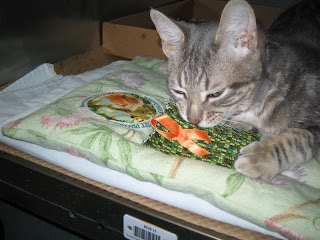
Next month, other volunteers will repeat our work. And then in June, Susan and some of her supporters will visit the [Animal Care & Control] shelter in another part of Brooklyn, to deliver the beds and toys, each one adorned with an orange awareness ribbon.
This is the second year of the Mother’s Comfort project. It is one of many innovative ways Susan Brandt and her Rational Animal organization publicize homelessness and enhance animal welfare around the City. After taking part in this event and being lavished with Sadie kisses, I have to say my own life was enhanced too.
-JERI DAYLE
[Jeri Dayle is a freelance writer, a keystone volunteer of Loving Touch Rescue in Queens, and an ardent supporter of Rational Animal. This is the 9th Rational Animal event--including two Gimme Shelter concerts, a Gingerbread Homes display and a Barking Arts gallery—that she has attended.]
We still need a sponsor for 2009-10, so help us out so that we can continue this great project and bring more awareness to animals in need, especially those at the Brooklyn AC&C.
From Jeri, after the April 2009 sewing session:
 “Do you think there really is a rescue gene?” I ask Susan. She has just told me that the woman’s face on the Mother’s Comfort patch is that of her grandmother, the woman who passed down her love of animals.
This is the kind of banter that goes on while we sew. We learn about one another: our names, our hobbies, our diets, our schools, our families. We discuss our different experiences with service dogs, pets, and rescue organizations.
You see, we did not know each other before we united on this stunning April day. We are women as young as 14 and as old as 51. Some of us are blonde, some auburn, some grey-haired. Some of us wear dresses, others wear Abercrombie tees or shorts. Some look like supermodels and actresses, others more like grandmas. One of us is even canine: Susan’s pet and our mascot, Sadie. However, there is one thing we have in common: the desire to make life a bit softer and a tad brighter for the homeless animals of New York City.
We are here in Flirt Home Ec, a chic boutique cum craft class cum sewing shop in Park Slope Brooklyn, helping to make animal toys and beds. Today, we are cutting various donated fabrics, snipping and stuffing batting, adding pinches of catnip, or operating sewing machines (some of us for the very first time).

Next month, other volunteers will repeat our work. And then in June, Susan and some of her supporters will visit the [Animal Care & Control] shelter in another part of Brooklyn, to deliver the beds and toys, each one adorned with an orange awareness ribbon.
This is the second year of the Mother’s Comfort project. It is one of many innovative ways Susan Brandt and her Rational Animal organization publicize homelessness and enhance animal welfare around the City. After taking part in this event and being lavished with Sadie kisses, I have to say my own life was enhanced too.
-JERI DAYLE
[Jeri Dayle is a freelance writer, a keystone volunteer of Loving Touch Rescue in Queens, and an ardent supporter of Rational Animal. This is the 9th Rational Animal event--including two Gimme Shelter concerts, a Gingerbread Homes display and a Barking Arts gallery—that she has attended.]
Saturday, July 4, 2009
NYCHA new pet policy investigation leads to chance meeting of an unexpected history
NYCHA new pet policy investigation leads to chance meeting of an unexpected history.
 Over the last couple months, I have been interviewing many people living in public housing, and whether they have pets or not, every individual I've spoken with has an opinion about the latest revision to the Housing Authority's "pet policy", which was first made public via appearing on the last page of The Housing Authority Journal, April 2009 issue.
An investigative story incorporating first hand experiences and feedback from residents in various housing developments, from East Harlem to the Lower East Side, this story has allowed me to meet people I never would have had a conversation with before, because I never would have had a reason.
Last week I happened upon a woman named Regina. A resident of the George Washington Houses, Building E, she has a 7 mo. old pit bull named Sparks, who is registered as a service dog. She also has a cat and a rabbit, but her cat just had three kittens. Disappointed to hear this, I realized she was another animal lover who did no t fully understand the importance of the various housing rules, including mandatory spay/neuter. But for some reason, that was a side thought in the conversation, as she told me about how she was on the cover of National Geographic, for a piece by journalist, Jere Van Dyk, titled "Growing up in East Harlem".
The story came out in May 1990, so nearly 20 years ago. Although she now has lupus and arthritis, she still exudes a lot of energy and has very strong opinions about animals and humane treatment of them. I don't mean to sound cheesy or cliche in my remarks -- I certainly wish she would neuter her pit bull and stop her cat from having more babies. It wasn't my place, for the purpose I was trying to achieve that day, to say my opinion. It didn't matter at that point, nor did it with any of my conversations with these residents.
In fact, I asked very few questions and just listened to her, as she also told me about a cat she and other residents take care of. I don't know what this cat's name is, so I just refer to him as Survivor Kitty.
This cat was actually a stray and a victim of cruelty, when some kids -- residents of R egina's building, though they are long gone -- wrapped a lot of rubber bands around his tail, forcing the hair to fall out. The same kids, Regina told me, threw fireworks at this cat, and one exploded near his face, blowing off a part of his mouth. Although these injuries are horrific, the cat is strong, now at least 15 years old (but who's counting). Regina and others I met that day feed the cat, let it inside to the basement in the Winter, and protect him from others. Regina made it very clear to me that she would not tolerate any cruelty in her neighborhood. If she saw it, she said, she'd have to 'kick some ass', as she put it.
As I watched the cat eat some food a couple older residents opened and put out for him, Regina said she had to go to the store, and she left.
Only after this conversation did I research and finally see the cover photo -- of her cr adling a puppy. It all made sense!
I looked high and low and finally tracked down a back issue I could order and have shipped to me. I plan to return to Regina's building and show her the cover. I think it would bring a smile to her face. Maybe that would be my in to talk about spaying and neutering...
The piece has become more layered than I anticipated, which is exciting. Should be out in a couple weeks. I certainly feel rewarded for having had the close interactions I did with so many different people. It's a tough economy -- and who am I to complain when I'm talking to some people who have very little. Aside from the assignment and my quest to find out not only how people feel about pets in housing, the rules or if they know what they are, and the way animals are treated by the good and not so good people, I only take interest in what is going on in their lives, because I know nothing about it but feel it matters if I am to be an informed writer and New Yorker.
Subscribe to:
Posts (Atom)