Showing posts with label animal care and control. Show all posts

Thursday, June 10, 2010

June 18th Fundraiser for NYC AC&C / Rational Animal donating advocacy merch for event

Rational Animal will provide Trails to Tails maps and Orange Ribbon for Animals merchandise at AC&C Fundraiser, June 18th
Contact sbrandt@rational-animal.org if you want to help us give out our Trails to Tails and Orange Ribbon for Animals merchandise.
Full details at TastingNYC - click here.

Date: Friday, June 18, 2010
Time: 6:00pm - 11:00pm
Location: BLVD, 199 Bowery (btwn Spring St. and Rivington)

Drink Special: $5 Bud/Bud Lights and $5 wine!
Admission: FREE!
BLVD is dog-friendly!

The event is co-hosted by one of the top names in New York radio, Maria Milito of Q104.3. C
heck out Maria's blog.

Tuesday, March 23, 2010

Please join us to deliver and sew beds for shelter animals

Saturday March 27th - we need your help delivering beds to the Staten Island AC&C. We will leave from West Chelsea late morning and return late afternoon.
Contact sbrandt@rational-animal.org to get involved!

Then NEXT weekend we are making more beds!
Saturday, April 3rd from 12-4pm
...at Flirt, Brooklyn (www.flirt-brooklyn.com) Home Ec Studio in Park Slope
303 3rd Avenue, Brooklyn NY 11215
Contact sbrandt@rational-animal.org or call (917) 239-9229


Monday, October 12, 2009

Investigative reporting on the NYCHA breed ban and lowered weight restriction

An exclusive investigative report for Rational Animal's media partner, New York Tails:


Writing and Reporting by Courtney Kistler
Edited by Diane West

Large dogs are a common in New York City's projects, but a new provision may change that. Residents and others speak out about how this new law will change, or has already changed, their lives and the lives of their dogs. But citywide, New York City's already overburdened shelter system may feel the effects of a flood of these now 'banned' dogs being surrendered by New York City Housing Authority residents (NYCHA) who fear of losing their apartments.

East River Houses resident Samuel* walked his two Rottweilers, 'Addy' and 'Nelson', from 105th Street and First Avenue to another nearby development, the George Washington Houses, one recent summer afternoon. Once there, he let the two large, seemingly tame dogs off their leashes for some exercise in the courtyard. Almost immediately, a woman begins arguing with him. She is afraid of the dogs and demands Samuel put them back on their leashes.
Samuel refuses. His dogs have never hurt anyone, he tells the angry woman, and they're under control. After a few more minutes of arguing she walks away cursing.


"I can't win," Samuel shrugs. By his own admission, he is an intimidating sight. Six foot five, dark skinned, tattooed, and flanked by two large dogs, he says he's an 'easy target' for both public housing residents and police officers alike.
"Kids as young as ten years old, looking to become Crips or Bloods, flash red or blue bandanas and threaten to 'blast' me because they think I'm a cop. And the cops? They think I'm fighting my dogs and doing other bad things, and they won't leave me alone."
Add to the kids and the police one more group who will have Samuel and other public housing residents under a more watchful eye-The New York City Housing Authority (NYCHA).

On May 1st, the Housing Authority, which is responsible for overseeing some 178,489 apartments throughout five boroughs, imposed a 25-pound weight limit on family dogs, almost half of the 40-pound weight limit instituted seven years ago. Additionally, the new rule specifically bans pit bulls, Rottweilers, and Doberman Pinchers from public housing, period. Residents may either have one pet dog or one pet cat but not both. All pets living with public housing residents must be registered with NYCHA. And, like all dogs in the city, they must also be licensed.
Dangerous Dogs
The new weight and breed rules do not apply to service dogs or to residents of Section 8 subsidized apartments, which NYCHA does not manage. But those who have had dogs over 40 pounds since 2002 and did not register them with the housing authority at that time may now face eviction. Some residents have already been told to remove their dogs.

"Over the years, we had been getting an increasing number of complaints about problems associated with dangerous dogs; dogs that are used for fighting, dogs that are attack dogs, and dogs that are not being handled and trained properly by their owners," says NYCHA spokesman Howard Marder when asked what prompted this latest change.

Many New Yorkers, NYCHA and non-NYCHA residents alike, were taken aback by the public housing authority's seeming haste to put the new weight and breed bans into effect. In addition to some initial glaring missteps, like the publication of a list containing the names of 27 so-called 'dangerous breeds' (which included the likes of Boston Terriers) the new rules seemed to contradict a New York State law which has long prohibited state municipalities from making laws which ban the ownership of specific dog breeds. To that, Mr. Marder says, "NYCHA is not a municipality. Therefore the rule does not apply." However, he says, NYCHA met with city animal advocacy organizations prior to implementing the new rule because "we didn't take [this] change lightly."


Residents, Animal Groups Taken By Surprise
"In no way shape or form did they [the Housing Authority] consult with us prior to coming up with this list, and we categorically reject breed discriminatory legislation," says an angry Jane Hoffman, President of the Mayor's Alliance For NYC's Animals and founding member and Chair of the NYC Bar Association Committee on Legal Issues Pertaining to Animals. "They only put out a notice to their tenants about a month before May 1st, and it came to our attention when residents started calling us in a panic."

The Mayor's Alliance and other city animal rescue organizations have a strong interest in the potential repercussions of NYCHA's weight-and-breed ban. Since its founding in 2002, the Mayor's Alliance has been the recipient of millions of dollars in grant money from Maddie's Fund, a national animal rescue fund created by software developer David Duffield in memory of the family's Schnauzer, Maddie. The Mayor's Alliance anticipates spending (and raising) a total of $24.4 million by 2016 to help reach their stated objective: reaching the day "when no New York City dog or cat of reasonable health and temperament is killed merely because he or she does not have a home."

"We are concerned from a policy standpoint, as we're trying to make New York a no-kill city," Ms. Hoffman says "We knew this [NYCHA] policy would cause an increase in shelter intake and the 25-pound weight limit would make it difficult for public housing residents to adopt from Animal Care and Control (AC&C). Seventy percent of dogs who come into the shelter system, according to the AC&C website, are pit bulls--one of the three breeds now banned from NYCHA projects.

It is impossible to say exactly how many animals have already ended up at the AC&C, the city's animal shelter system, as a result of the new NYCHA rules. But if early predictions are correct, the number of dogs turned in could be substantial.
According to Debora Bresch, ASPCA's Legislative Liaison in Government Relations, six percent of all dogs available for adoption from the AC&C were adopted by public housing residents between January and April 2009, a total of about 172 dogs. Under the May 1st NYCHA rules, 107 of these 172 dogs - over 60% - are not supposed to be there, making them prime candidates to be returned to the city's shelter system.
Early attempts to discourage city housing residents from surrendering their animals before knowing what their rights are under the new rules include the distribution of a memo in several languages at each of the city's shelters. (The English version of the memo can be accessed here:
www.animalalliancenyc.org/ press/memo2009-06-08-English.pdf ).

There were 4,656 dogs and 1,264 cats registered as pets of housing authority residents when the May 1st policy went into effect but, Mr. Marder says, NYCHA did not keep records of them by breed. However, he says, NYCHA will use its "limited resources to address lease violations such as this as well as all other lease violations or Quality Of Life infringements or crimes as it is made aware of them."

Pitbulls in the Projects

Public housing residents are among the first to admit pit bull fighting and animal abuse are common within certain housing projects and must be stopped. But several interviewed for this article feel the new NYCHA rule is too broad and unfairly affects people and pets who never have, nor would, do anything criminal with animals.

One of those fighting against NYCHA's new pet rule is 26 year-old Marquis Jenkins, community organizer for a tenant advocacy group called the Good Old Lower East Side (GOLES). Mr. Jenkins has been circulating and gathering thousands of signatures for a petition against the new policy. At the crux of his efforts is a request that NYCHA "halt any and all evictions in association with the [new] pet policy".

Supported by Councilwoman Rosie Mendez, Chair of the New York City Council's Subcommittee on Public Housing, Mr. Jenkins asserts that nearly all the dog owners that have joined the fight against the policy with GOLES have received a letter from NYCHA-- the first step of the eviction process. Some have refused NYCHA management's request to remove their pets. Their next step is to schedule a hearing at the NYCHA head offices at 250 Broadway.

Back uptown at the George Washington Houses, 70 year-old resident Gladys and her seven year-old pit bull, "Dream", say they've had run-ins with NYCHA long before the May 1st rule went into effect. When Dream was still a puppy, Gladys says, a resident complained to the Housing Authority that Gladys' dog was vicious. Gladys found herself not only having to prove allegation false in order to keep Dream, but to keep her apartment as well.
"So I took pictures of her playing with people, with children, and I got a petition, because all [the] people are crazy about her." Eventually, NYCHA ruled in her favor. A public housing resident for 38 years, Gladys says she's received a written notice in the mail regarding the pet policy change but is unconcerned. Dream is registered, spayed, with vet certification, and although over 40 pounds, is exempt from the weight limits because she is considered a type of service/ therapy dog for Gladys.
Gladys says she took Dream as a four-month old puppy from her niece, because "I didn't want her to fall into the wrong hands. My niece was being offered hundreds of dollars for this puppy." People willing to purchase Dream at such a large price, she believes, were looking to either breed her or use her for fighting - or both.

Gladys' friend, Moncit*, agrees. She's witnessed firsthand what she believes were people training dogs for fighting. "Last Summer, right there," Moncit recounts, pointing to a large tree in the courtyard, "is where I saw a rope hanging. A pit bull was holding onto it with his jaws, swinging from this rope, while a man was whipping it with his belt over and over again.

"This used to be a breeding ground for pit bulls," says Marietta, who has lived in public housing for 52 years and currently lives at the Washington Houses. Up until about two years ago, she says, the problem was easy to see. "They used to fight dogs wherever - it did not matter. In the street, on the sidewalk, right here in this yard," she says. She is standing in front of the same area Samuel had let his Rottweilers run earlier that day.

The housing authority's ban on pit bulls and other breeds often favored by dog fighters does have some unlikely supporters, however. One of them is Emelinda Navarez, a life-long resident of the South Bronx and founder of Earth Angels Canine Rescue. Over 45 years, Ms. Navarez estimates she's rescued over 6,000 pit bulls in and around her neighborhood. Another is Stacy Alldredge, a Chelsea resident who has a dog training business and has worked at animal shelters as well as been involved in animal rescue for more than two decades. Both Emelinda in the Bronx and Stacy in Chelsea think the NYCHA ban on pit bulls may be the right thing to do.

Other advocates, who don't support the ban, nonetheless acknowledge there is a problem, problems which have not necessarily ceased since implementation of the new policy. On July 8th, police called to check out a disturbance at the Stanley Isaacs Houses East 94th Street shot and killed a pit bull during the melee, according to a Daily News report. Weeks later, a 19 year-old boy was arrested for throwing a young pit-bull mix off a roof in Brooklyn's Red Hook housing development. And on September 29th, a trial will begin against seven men who were arrested during a police raid of an East 179th Street building where the basement and yard was allegedly used to carry out an organized dog fighting operation. (See the homepage for the NYC Anti-animal Fighting Campaign (
http://stopdogfightingnownyc.wetpaint.com) for more details.)

As residents have attested, there is no doubt that mistreatment, recklessness, and irresponsible behavior when it comes to animals in public housing take place and causes quality of life issues. Whether or not the NYCHA ban on pit bulls, Rottweilers, Dobermans, and dogs over 25 pounds will put a damper on these things, which have created the problems that Mr. Marder says residents have complained about, remains to be seen. As the 90 day grace period has just past, New York Tails will keep a close eye on NYCHA's enforcement of its new policy and its effect on the city shelter system, as well as progress by those who are part of the effort to repeal the rule.
As for Addy and Nelson, just a few weeks after being interviewed for this article, Samuel relinquished the pair to Manhattan AC&C on 110th Street, saying that he is trying to save up money to move away from New York and cannot do so while also providing for the animals. Luckily, the pair were removed from the shelter by a Rottweiler rescue group and eventually found a new home in Vermont.

* Only first names of public housing residents have been provided to protect their privacy.
_____________________
Life is the Pits -- The NYC Pit Bull and Pit Mix Rescue Meetup
By Laura Osanitch
Chelsea resident Amy Calmann, adopted her pit bull 'Patti Smith' from the New York Center for Animal Care and Control in 2003. She became so enamored of her warm and wiggly new friend she created the NYC Pitbull and Pit Mix Rescue Meetup, a group where pit bull owners could come out of the canine closet and show their love for their breed of choice. Today, 586 happy members gather all over the five boroughs.

Meetup member Cris, who requested her last name be omitted, joined the Meetup partly in response to comments made like that of a former boss, who noticed her dog's picture on her desk and chastised her for owning a pit bull. Shocked, Cris still remembers her eyes watering up as she hid her precious pet's photo in a drawer.
"It hurts my feelings when people react so angrily or frightened towards my dog, whom I love," Cris says, who was thrilled to meet likeminded people through the Meeutp.

Other members feel the same way. Ingrid and Francisco Rodriguez of Bushwick adopted their pit bull, 'Blanco' in September 2008. Abandoned, Blanco was in need of a hero, and the Rodriguez's answered the call. Since adopting 'Blanco', however, Ms. Rodriguez says she's found herself in situations she never bargained for, including what she describes as "thugs expressing their admiration," for her dog and a "dicey" bodega employee who, upon sighting Blanco, released a mistreated pit bull from a basement in what Ms. Rodriguez thinks was an attempt to incite a fight. The Rodriguez family is glad to have found the Pit Bull Meetup, where they feel they can make friends and create positive experiences for their precious pooch.

Jon Bozak, author of graphic novel, Demo-The Story of a Junkyard Dog, is also a member of the NYC Pitbull Meetup and is the owner of two pit bulls; 15-year-old "Demo" and two-year old "Brinx." Mr. Bozak says his dogs and his book have served as a catharsis for his views on many issues, including judgment on appearance. He suggests: "People today are short on time and can't be faulted for forming fast opinions. But they should learn what they are forming opinions on. Be open to discussion."

Thursday, August 20, 2009

Exec Director of NYC Animal Care and Control to depart

The Executive Director of NYC Animal Care and Control, Charlene Pedrolie, will not be renewed in October, according to a New York Tails breaking news story.
Some rescuers and volunteers signed a petition, which was started by Laurie Bleier, Director of Brooklyn Animal Foster Network, which called for her firing or resignation. Bleier used to be heavily involved with Animal Care and Control, taking on the "Animals Didn't Do Anything" advertising campaign which used mug shots of dogs and cats at shelters to advocate for adoptions from AC&C. Though it remains unclear why, Bleier and BAFN no longer are a part of the community of rescuers that may pull animals from AC&C. Bleier has been outspoken, but it seems media have had a hard time getting rebuttal from AC&C, by the way this Brooklyn Paper article reads. On the other hand, Bleier has been accused of having a less-than-perfect track record according to other media.
The deal on Charlene is mixed, though, in my experience with rescuers and advocates in the city, she was not liked by many, but she did have a couple fans within AC&C, who I know. At this point, energies should be directed at the odd pairing of government entity and non-profit within one body that is NYC AC&C. Like changing the GM of the Mets, until the house is sorted out inside, doesn't matter who's at the healm.

The problem really lies in the job itself and the way AC&C functions -- which is as both a city-run entity AND a 501(c)(3) non-profit. That means that, although it is a high-kill shelter, the city, the top management, and staff are under pressure to paint a picture of functionality and improvement in order to get the desperately needed donations from the public. One group, Dogs in Danger, tried to post animals at AC&C that were on the euth list, and they succeeded until, the blog says, Pedrolie came aboard and said no, because it was bad for the AC&C image. Luckily the New Hope Program sends alerts out to hundreds of rescuers every day with animal pictures and their bios, in hopes that they can be saved. In addition, people on this email list cross post to outsiders, on social networks such as Facebook, and on Craigslist. It seems that the image issue concerning going public with the pleas for saving soon-to-be-euthanized animals has dissipated. I believe this is a good thing. If more of the public really understood what a crisis level we are at in terms of animal homelessness and euthanasia, they may opt to walk past the pet store and straight up to 110th Street to the Manhattan Animal Care shelter.

The key problem for AC&C is that the system is grotesquely underfunded, and I believe that this government/private non-profit contruct is at the crux. I have met at least one person who will not give money to a kill shelter. I think that is ludicrous. Any municipal shelter that must take in animals brought to it must euthanize -- it is a necessary evil. By neglecting the operations there by either not volunteering or not giving donations, hurts only the animals.

The ASPCA dumped the AC&C on the City in 1993, and the Department of Sanitation was the part of City government that took control. Power was transferred over to the Department of Health, however, as the City deemed it in better taste. DOH has had full control of the Board for AC&C as well as the appointment of Executive Director and other top management. The DOH oversees all, and many activists for shelter animals here in the city have taken issue with that, calling for a specific department for domestic animal and wildlife, apart from the DOH. Given that the animal shelters used to be controlled by Sanitation and moved to Health, this perhaps is a natural progression as the country learns just how critical the fight against overpopulation and neglect and cruelty is today.

At one point, a crew of proactive New Yorkers operated a reform committee called the Shelter Action Reform Committee, whose mission statement is "To improve conditions and accountability in the New York City animal shelter system through education, lobbying, legislative initiatives and legal action." It is uncertain whether or not the SARC is still active in its mission, but those who started it, including former President of United Action for Animals, Gary Kaskel, have moved on.

Stay tuned to New York Tails for more...never a dull moment!

Tuesday, July 7, 2009

Mother's Comfort Project testimonial: sewing cage comforters

Please see below another testimonial for the Mother's Comfort Project.

We still need a sponsor for 2009-10, so help us out so that we can continue this great project and bring more awareness to animals in need, especially those at the Brooklyn AC&C.

From Jeri, after the April 2009 sewing session:

“Do you think there really is a rescue gene?” I ask Susan. She has just told me that the woman’s face on the Mother’s Comfort patch is that of her grandmother, the woman who passed down her love of animals.

This is the kind of banter that goes on while we sew. We learn about one another: our names, our hobbies, our diets, our schools, our families. We discuss our different experiences with service dogs, pets, and rescue organizations.

You see, we did not know each other before we united on this stunning April day. We are women as young as 14 and as old as 51. Some of us are blonde, some auburn, some grey-haired. Some of us wear dresses, others wear Abercrombie tees or shorts. Some look like supermodels and actresses, others more like grandmas. One of us is even canine: Susan’s pet and our mascot, Sadie. However, there is one thing we have in common: the desire to make life a bit softer and a tad brighter for the homeless animals of New York City.

We are here in Flirt Home Ec, a chic boutique cum craft class cum sewing shop in Park Slope Brooklyn, helping to make animal toys and beds. Today, we are cutting various donated fabrics, snipping and stuffing batting, adding pinches of catnip, or operating sewing machines (some of us for the very first time).

Next month, other volunteers will repeat our work. And then in June, Susan and some of her supporters will visit the [Animal Care & Control] shelter in another part of Brooklyn, to deliver the beds and toys, each one adorned with an orange awareness ribbon.

This is the second year of the Mother’s Comfort project. It is one of many innovative ways Susan Brandt and her Rational Animal organization publicize homelessness and enhance animal welfare around the City. After taking part in this event and being lavished with Sadie kisses, I have to say my own life was enhanced too.

-JERI DAYLE

[Jeri Dayle is a freelance writer, a keystone volunteer of Loving Touch Rescue in Queens, and an ardent supporter of Rational Animal. This is the 9th Rational Animal event--including two Gimme Shelter concerts, a Gingerbread Homes display and a Barking Arts gallery—that she has attended.]

Thursday, June 25, 2009

SPOTLIGHT ON: Emma (A816658). Blind pittie that is a lovely joyful gal!

At Manhattan AC&C is a very special lady...
Emma (A815558), 4 yr old female pit – one of the sweetest and fearless pits I’ve ever met. She just wants to meet everyone. She’s constantly wagging her tail and making friends. She is quiet in her crate and when she comes out she is actually fairly good at getting around...this leads us to believe her vision is limited to shadows…or she has been blind all her life and has developed a strong enough sense of surrounding to be able to feel her way through things. I can’t say enough great things about her personality, cheerfulness and beautiful temperament. She is always eager to please and is a true joy to be around. It’s impossible to be around this dog and not feel happy!

AC&C VOLUNTEER WROTE: Sweet as sugar, confident in her blindness. Emma, who is blind, was found wandering the streets on 6/23/09. This volunteer has had two blind dogs of her own, but neither was as confident and trusting as Emma. She's willing to find her own way around, but is grateful if you lead her, too. She loves people and wants to kiss you -- all the time -- to show you her love. We figure she's around 4 years old. We don't know what caused her blindness, but nothing has dimmed the lightness of her soul. She's a joy.

---
Contact me (Courtney) if you're interested in Emma or any animal for adoption.
We REALLY need more foster homes.
Find ALL adoptable dogs and cats here: http://www.nycacc.org/adoptionsearch.htm
A-number is for AC&C to better help you meet the dog you are interested in. Please use it if you contact AC&C directly or visit the shelters.

---
ATTENTION ANIMAL LOVERS! BROOKLYN NEEDS YOU!

AC&C in Brooklyn really needs more volunteers!! Contact ckistler@rational-animal.org if you can help. Every little description, personal testimonial for an animal drastically increases their chance for adoption.
AC&C Brooklyn
2336 Linden Blvd (East New York)
3 train to New Lots; walk up New Lots four blocks to Essex, make a right, walk two avenue blocks to Linden Blvd, and see shelter between Essex and Shepherd Ave.

Saturday, June 13, 2009

Victory for Dogs and Advocates yet More Delays in Vick-like Dog Fighting Trial, Bronx, NY

Victory for Dogs and Advocates yet More Delays in Vick-like Dog Fighting Trial
Bronx, NY

The case was last heard on June 11, 2009 before Judge Steven Barrett (Docket #02688-2008). Two of the defendants with misdemeanor charges, Israel Cuevas and Alterik Mason (they were spectators, not dog fighters) were hoping to plea out but thankfully the Judge and ADA Jacob Kaplan rejected their plea and confirmed that their case would go to trial with the others.
Jennifer Panton, President of United Action for Animals and Director of the New York Anti-Animal Fighting Campaign, a partnership with UAA and NYC Animal Care and Control, said “It will be interesting to see what Cuevas and Mason receive. I feel it’s important to mention that currently NY state is rated nearly the worst (48th) in the country, yet NJ is rated the best.”

Summary of New York State charges for dog fighting:
(1) Dogfighting: Felony, Max 4 years, Max $25,000
(2) Spectator at a Dogfight: Misdemeanor, Max 1 year, Max $1,000
(3) Possession of Dogs for Fighting: Max 1 year, Max $15,000

You can
click here to see state rankings for dog fighting laws – note the stark difference between ranking for New York and for our neighbor, New Jersey. Please note that on June 2, 2009, an amendment to the current law passed. For the full details, refer to an earlier post about this.

On June 16, 2009, Alexander Estephane, Juan Toledo, Lauritz Acoy, who received felony charges for dog fighting (and Cuevas, Mason misdemeanor charges as spectators), will face the same hearing, where final charges will be made official. They already do not have a chance at plea deal. In other words, all five defendants will be charged with the maximum crimes – no charges have been or will be reduced.
There is a sixth person, Rashan Johnson, who Panton believes is AWOL and is waiting from the ADA for confirmation.

Delay in setting trial date

While the news about the charges is good for the prosecution and advocates showing up to each hearing, making their presence known for the ADA and the Judge, the bad news is that there are more delays in establishing a trial date.
Judge Steven Barrett (Docket #02688-2008) who set another hearing date of July 8th to establish a trial date for all 5 defendants also calendared July 27th as an estimated trial date for all defendants. The ADA, thankfully, had requested that both misdemeanor and felony defendants to stand trial together rather than separate trials. However, after the hearing finished on Thursday morning, ADA Kaplan told us that the July 8th hearing was merely to “discuss” a trial date, admitting that because there are six attorneys involved (including himself) there will be conflicting trials and summer vacations to contend with, and, therefore, the July 27th tentative date will likely will get pushed back.

Petitions and letters to Judge help uphold the no-plea deal

Kaplan thanked us for the help with the plea option, and by that, Panton says, “I think all the letter writing to the judge and [online] petition helped”.
See below her letter to Judge Barrett.

--
From Jennifer Panton, United Action for Animals
Wednesday, June 10, 2009

Dear Judge Barrett,

Please see the attached document which contains over 1,500 signatures from a petition regarding the Bronx Dog Fight Case (Docket #02688-2008). This petition and signatures can also be view at:
http://www.thepetitionsite.com/126/stop-animal-fighting-in-new-york-city

We would like to express to you that the defendants should be given no plea deals and have a speedy trial date established at their June 11th and June 16th hearings, as these alleged crimes were committed over a year ago with overwhelming evidence (i.e. one dog died on the way to the shelter that night).

Regarding the two defendants, Israel Cuevas and Alterik Mason, that were already lucky enough to dodge felony charges due to current law, please note that on June 2, 2009, the NY Senate’s Agriculture Committee unanimously passed S.3926, to increase penalties for spectators at animal fights as well as for persons possessing animals for the purpose of fighting (please see press release attached for your reference).

Additionally, please keep in mind that animal fighting does not occur in a vacuum. Animal fighters are violent criminals that engage in a whole host of peripheral criminal activities. Many are heavily involved in organized crime, racketeering, drug distribution, or gangs, and they arrange and attend the fights as a forum for gambling and drug trafficking.

Thank you for your time.

Jennifer Panton
President
United Action for Animals
P.O. Box 635
New York, NY 10021
Tel: 212-249-9178
www.ua4a.org

--
The online petition was exported into a document, which Panton references above. She says, “our petition elaborated about our stand – that New Yorkers want these criminals punished to the max for these heinous crimes and to rid animal fighting out of our great City.

Please sign this petition – we need as many signatures as possible for continued letters and evidence that we are not going anywhere, that we represent a large constituency of voters and influentials that stand strongly for the prosecution and conviction of people who commit dog fighting.
http://www.thepetitionsite.com/126/stop-animal-fighting-in-new-york-city

Official Summary of Case:
--
INDICTMENT
Supreme Court of The State of New York
County of Bronx
__________________________________________________
People of The State of New York -Against-

Alexander Estephane, Docket # 36626C-2008
Lauritz Acoy, Docket # 36624C-2008
Juan Toledo, Docket # 36622C-2008
Rashaan Johnson, IBNA
Israel Cuevas, Docket # 36625C-2008
Alterik Mason, Docket # 36623C-2008
Defendants.
__________________________________________________
Indictment # Grand Jury # 43788/2008
COUNTS
Prohibition of Animal Fighting
Agriculture and Markets Law § 351 (2)(a)
(count one)
Prohibition of Animal Fighting
Agriculture and Markets Law § 351 (2)(d)
(count two)
Prohibition of Animal Fighting (four counts)
Agriculture and Markets Law § 351 (4)(b)
(counts three – six)
A Panel, 8th Term
August 1, 2008
A True Bill

ROBERT T. JOHNSON
DISTRICT ATTORNEY
_______________________
FOREPERSON

FIRST COUNT
The Grand Jury of the County of the Bronx, by this Indictment, accuses Defendants Alexander Estephane, Lauritz Acoy, Rashaan Johnson, and Juan toledo of the Crime of Prohibition of Animal Fighting, in violation of Agriculture and Markets Law § 351 (2)(a), committed as follows:

Defendants Alexander Estephane, Lauritz Acoy, Rashaan Johnson, and Juan toledo, acting individually and in concert with each other, on or about June 14, 2008, in the County of the Bronx, for amusement or gain, caused any animal to engage in animal fighting.

SECOND COUNT
The Grand Jury of the County of the Bronx, by this Indictment, accuses Defendant Alexander Estephane of the Crime of Prohibition of Animal Fighting, in violation of Agriculture and Markets Law § 351 (2)(d), committed as follows:

Defendant Alexander Estephane, on or about June 14, 2008, in the County of the Bronx, permitted animal fighting to occur on premises under his control.

THIRD COUNT
The Grand Jury of the County of the Bronx, by this Indictment, accuses Defendant Israel Cuevas of the Crime of Prohibition of Animal Fighting, in violation of Agriculture and Markets Law § 351 (4)(b), committed as follows:

Defendant Israel Cuevas, on or about June 14, 2008, in the County of the Bronx, was knowingly present as a spectator having paid an admission fee or having made wager at a place where an exhibition of animal fighting was being conducted.

FOURTH COUNT
The Grand Jury of the County of the Bronx, by this Indictment, accuses Defendant Alterik Mason of the crime of Prohibition of Animal Fighting, in violation of Agriculture and Markets Law § 351 (4)(b), committed as follows:

Defendant Alterik Mason, on or about June 14, 2008, in the County of the Bronx, was knowingly present as a spectator having paid an admission fee or having made wager at a place where an exhibition of animal fighting was being conducted.


FIFTH COUNT
The Grand Jury of the County of the Bronx, by this Indictment, accuses Defendant Rashaan Johnson of the crime of Prohibition of Animal Fighting, in violation of Agriculture and Markets Law § 351 (4)(b), committed as follows:

Defendant Rashaan Johnson, on or about June 14, 2008, in the County of the Bronx, was knowingly present as a spectator having paid an admission fee or having made wager at a place where an exhibition of animal fighting was being conducted.

SIXTH COUNT
The Grand Jury of the County of the Bronx, by this Indictment, accuses Defendant Juan Toledo of the crime of Prohibition of Animal Fighting, in violation of Agriculture and Markets Law § 351 (4)(b), committed as follows:

Defendant Juan Toledo, on or about June 14, 2008, in the County of the Bronx, was knowingly present as a spectator having paid an admission fee or having made wager at a place where an exhibition of animal fighting was being conducted.

Scheduled Arraignment Date: September 8, 2008

Arraignment Part: Part 60
Other Associated Indictments: None

Completed: August 1, 2008
A.D.A. Jacob Kaplan
Rackets Bureau

---

Protests, showing up to court, media, buzz...
While most of our court advocacy has been just showing up to court (sitting in the audience), at each of the seven hearings, to make the judge, ADA, and defendants know that we are watching them and supporting the voiceless victims, Jennifer and several others have led one protest and there will be more such activism once the trial starts.

Personally, and I wrote Amy Sacks of the New York Daily News this, I know that my goal, which I'm sure Jennifer and others share, is to make an example out of this case, as a local Michael Vick case, the Vick wanne-be being, of course, Alexander Estephane. The extent to which the accused had set up their training facility in the basement of the Tremont, Bronx, house is not unlike that of the Vick compound – only it was indoor and a small backyard, a more confined space (it's New York City, after all...). According to the Daily News article which came out the day after nine men were arrested, "They [NYPD] found an animal house of horrors filled with bite sticks used to separate dogs during jousts, syringes, painkiller medication, weigh-in scales - and a 9-by-9-foot fighting pit, police sources said. Rusted metal and wooden cages heaped with dog waste were found in the backyard of the E. 179th St. building. One dog, showing fresh injuries from a recent battle, died while being rushed to a shelter [NYC AC&C] for treatment."

The mindset of these people, their will to torture animals and watch them writhe in pain, to gamble and live outside the law, is all the same. Should people in New York who really followed the Vick story turn their eyes on a nearly identical case happening in their own city – the support on our side, media coverage, and buzz surrounding it would have far reaching implications, including that of educating people, inspiring teachers and parents to talk to their children about animal fighting cruelty, cruelty in general, open more eyes of the NYPD so they take reports of fighting and cruelty more seriously, etc.

The movement behind this case has the potential to be characterized as a local version of that behind the Vick story. Hopefully a larger grassroots effort will build within Jennifer Panton's NYC Anti-animal Fighting Campaign and we can really show New York that they can't turn away from it anymore, because it is happening here and it's that bad.

See link here to today’s Daily News article, quoting Jennifer Panton, regarding this case, coverage for which I helped facilitate and will continue to do so for all media as much as I can. Media coverage for the trial is especially important, and I’m committed to working hard to get it. We need the media to reach New Yorkers, inform those who don't know about the case as well as affirm the compassionate supporters trying to help.

Television coverage is especially important for Day 1 of the trial. More exposure means more access to the public, more people will pay closer attention to this potentially precedent-setting case.

If you are a member of the media or have a media connection, please contact me to get details on the latest with this story.

Courtney Kistler, ckistler@rational-animal.org, 212.933.1688

Tuesday, June 9, 2009

Alleged Dog Fighters Go Back To Court, Bronx, NY, June 11th and June 16th

Alleged Dog Fighters Go Back To Court, Bronx, NY, June 11th and June 16th
PLEASE HELP YOUR FELLOW ANIMAL LOVERS AND PIT BULL ADVOCATES SUPPORT THE PROSECUTION OF THE BRONX MEN WHO RAN AN ORGANIZED DOG FIGHTING RING
Bronx, New York, June 9, 2009

Join United Action for Animals in court this Thursday, 6/11/09 and next Tuesday 6/16/09 for the 16 victims with no voice.
Please be there at 9:00 am @ Bronx Court, Hall of Justice, 265 East 161st Street (4 train to Yankee Stadium), Bronx, NY. Be prompt so you don't miss the hearing, as there is a long security line at the entrance.
More info and location details
here.
-------

This is a heinous crime -- Estephane's basement was used as a training facility for fighting dogs, not unlike Vick's property was. These were not amateurs, and they'd been running the fighting ring for some time, as was Vick, before his place was finally discovered. So, essentially, my goal is to help make an example out of this case for bringing attention to NYC dog fighting crime, as the large orgs and media did for the Vick case for bringing attention nationwide to the crime of dog fighting in general.


Please show you will NOT tolerate dog fighting in your city! This type of animal cruelty needs more exposure so that children will learn that this is a crime and not take after those who may tempt them into participating, even watching, animals tear each other to shreds in order for humans to make money.

-------
BACKGROUND:
Five alleged dog fighters and spectators will go back to court in New York City at Bronx Court, Hall of Justice, 265 East 161st Street, Bronx, NY, on charges related to a Bronx dog fighting bust last summer.

The cases were last heard on May 13, 2009 before Judge Steven Barrett (Docket #02688-2008) who set the following hearing dates:
(1) Thursday, June 11: Judge will make a decision in regard to requests by both Cuevas and Mason to plead out. If the judge rules against them, they will be included in the trial with the other three men.
(2) Tuesday, June 16, a trial date will be set for Alexander Estephane, Lauritz Acoy and Juan Toldo on felony dogfighting charges.
-Isreal Cuevas and Alterik Mason will face misdemeanor charges because they were spectators, not dog fighters, unless they are allowed by the judge to plead out.

Almost exactly one year ago, on June 14, 2008, NYPD, acting on a tip from the New Jersey state police, rescued 16 pit bulls and two roosters from the back yard of a house at 108 East 179th Street in the Tremont section of the Bronx that doubled as a dog fighting ring. One of the dogs, that appeared to be badly hurt, died on the way to a shelter. Officers recovered $2,000 in cash and syringes used to inject the dogs with stimulants.Police arrested seven men from the Bronx and New Jersey. The suspected ring leader, Alexander Estephane, 44, lives in the Bronx building that neighbors have long believed housed the inhumane and illegal blood sport. The other men were identified as Lauritz A. Acoy, 41, and Eric A. Boyce, 33, both of the Bronx, and Israel Cuevas, 34, Juan Toldo, 38, Alterik Mason, 29 and Darnell Walker, 34, all of New Jersey.

The next day, in a separate matter of animal cruelty, Israel Cuevas was charged by the New Jersey SPCA with failure to provide food and water to animals residing at his home, 5 adult pit bulls and 12 pit bull puppies, in North Brusnwick, New Jersey. Cuevas, a senior correction officer at the New Jersey Training School for Boys, in Jamesburg, New Jersey, pled guilty to the charges and was fired from his job. Charges against Boyce and Walker were dismissed.

United Action for Animals (UAA), a New York City non-profit humane organization, has created an Anti-Animal Fighting campaign to assist with court advocacy, awareness, animal foster care and pro bono legal assistance for the Animal Care and Control of New York City, the shelter that cares for the victims.

For more information see:
www.ua4a.org/AntiDogFighting.html
http://stopdogfightingnownyc.wetpaint.com
http://www.petabuse.com/cases/13875/NY/US
http://www.nycacc.org

Contact:
Jennifer Panton, President
United Action for Animals
P.O. Box 635
New York, NY 10021212-249-9178

---------

Many of the pit bulls that cruel people try to use for dog fighting end up at Animal Care and Control.

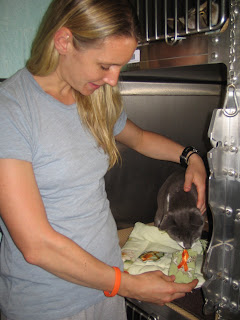
Brooklyn AC&C, bed delivery for Rational Animal's Mother's Comfort Project (Jan 11, 2009)

This little guy was so sweet. You can see his ears have been cropped -- he was probably used for dog fighting (had scars on his face and legs), and often the ears are cropped (as in literally the top half is cut off when the dog's a puppy) to make the head look bigger or to not get in the way when another dog is attacking its head.
Dog fighting is plain, abominable animal cruelty, and it's illegal.

And many of the dogs -- the lucky ones -- like this guy are still sweet, loving, adoptable companion animals that don't have a fighting bone in their body...which is often why they are dumped out on the streets.

Thursday, May 28, 2009

The Mother's Comfort Project - FAQ

UPDATE on The Mother's Comfort Project

We made 40 beds yesterday (Saturday) with HEART (Humane Education Advocates Reaching Teachers) and some awesome volunteers, along with 20 new cat toys! In the picture here you'll see HEART coordinators, Gage, a 7-yr old student, and Sadie, our Director's adopted pit bull, who she met on a delivery trip for the Mother's Comfort Project last year!

Delivery of our beds and toys from yesterday and from our April public event is set for next Saturday, June 6th. We're so excited!

Having delivered over 700 beds to the Brooklyn Animal Care and Control shelters, we're very proud of our work and diligence in making shelter life for animals a little more comfortable. We add a touch of love to every bed and cat toy, and we believe each animal we bestow these gifts to feels it.

The Mother's Comfort Project was recently featured in Time Out New York as "Cause of the Week"!!

Here are some things Sharon Steel of TONY asked me and my answers to them. The below gives an insider's insightful view of the real meaning behind the project.


What has the experience meant to you -- both in terms of sewing the beds themselves, and delivering them to the shelters for the animals in need?


I like the social aspect of it- we talk about a lot of animal awareness and related issues while at the sewing and fabric tables. We share funny stories about our dogs and cats, and it's also a great way to meet potential volunteers for our other media and outreach projects. In addition, Patti Gilstrap, co-owner of Flirt, has been amazing in hosting the monthly event and helping everyone with the sewing machines. We would never have had nearly the success we've had if it wasn't for Flirt and the owners there.

Visits to the Brooklyn AC&C to deliver the beds is the best part of this project. I have cats but love all animals, so I welcome the chance to interact with the dogs, in addition to cats. When I see dogs with scars on their face, head, body, and I can tell it is from dog fighting, I am reminded that this form of animal cruelty is still very much a reality and must be stopped...and then it just amazes the heck out of me that they are also the sweetest animals, full of vitality and personality. It is not what most people expect but that's the reality. Dogs are truly amazing animals!

I also know that many of the dogs and cats we meet will get a chance at a better life in a new home with a new family. Some cage signs will have "Adopted" printed on them, so going to the shelter and seeing that is really rewarding since so many of us and others in rescue and awareness work so hard to educate people on shelter and rescued animals and that adoption is the only option.

So in summary, the bed delivery gives us a chance to see the reality of the homeless animal population first hand and to also see that the animals for adoption at the AC&C shelters are beautiful, wonderful companions that would thrive in a person's home. I take that with me, use these personal experiences in conversation with others whenever I can.


One specific anecdote would be wonderful. For example, did you develop special bonds with any of the animals you brought beds to?

When Susan and I went a few months ago, we saw a chicken. He was in one of the cages (a different room from the dogs, cats) and looked like he was in rough shape, pretty sad. We gave him a bed, though. I have always loved farm animals as well as cats and dogs, so I was glad to have an opportunity to show a little love to one. All animals should be treated well, taken care of, including farm animals, of course.


Some volunteers also feel compelled to adopt after they see the animals. Has that happened to you as well?

Not really -- I know I have a full house, and my main focus is on the public, people who want a pet and may not know much about adoption, where to go, or may be susceptible to going into a puppy/kitten shop. Some day I'll have a house and a big yard, and then I will definitely adopt a big dog!We take many pictures every time we go and we can share them with people via the website or other online mediums. I think it helps for the public, including our friends and family, to see pictures of people just like them interacting with animals in a shelter, especially larger dogs which may seem intimidating to some people at first. I think photos like this can help shift one's image of a city shelter, which is certainly part of what we do.


Finally, why do you think TONY readers should care and get involved, perhaps donating their time to delivering beds or their own sewing skills to the project?


There is no other project like this around NYC -- draws on people's creativity and compassion for animals. Plus each bed is made by an individual -- so it's like a gift from you, if you were to participate, to a shelter animal. It's very personal, and we always take tons of pictures so everyone can see how their work is directly helping animals -- and people. The beds are a great contribution to the staff and volunteers at AC&C. They can wash and reuse the beds, and they do not have the budget to purchase such durable quality beds for the animals. They are very grateful and express it every time we're there.
---------

Friday, May 22, 2009

More BSL conversations...

Breed specific legislation...continues in body of law and mind.

Earlier today, I called the Toledo Animal Shelter. I have been trying to reach them to inquire about pit bulls. I have noticed they never have any up for adoption. Finally, I got someone on the phone, and she explained to me that their insurance will not allow them to house pit bulls in their facility. The insurance company views them as vicious. I didn't get the name of the insurance as I was transferred to the Lucas County Dog Warden, but I'm sure whatever it was, it's not the only company that insures shelters therefore determines a lot of their rules.

So, I talked with a woman at the Lucas County Dog Warden, a department of Lucas County, of the state of Ohio. I grew up here (Toledo, OH), and I know that the city, even the entire state is not progressive in the animal awareness and rescue realm. I would say that I had a great conversation with Tom Skeldon, Toledo's Dog Warden. And the more I hear the pro-BSL side of the debate, the more I learn about how so many dogs, mainly pit/pit mixes, are exploited, abused, and ultimately discriminated against, and at the expense of their lives.

I also know that Skeldon is skilled at speaking to people like me, who are advocates for breeds such as pit bulls, which are often sentenced to death simply for being "at large", as Skeldon puts it. That is a municipal-ish word for stray. Skeldon has convinced members of the public that pit advocates are 'cults of personality' who have little backing. Skeldon wields power only because his father, Ned Skeldon, after whom Toledo Mud Hens field was once named, gave him a job. He knows Toledo, and he knows how to talk back to those challenging him on his anti-dog views. He need not speak truthfully, only convincingly.

In Toledo, pit bulls have been made out to be a public enemy, not because of pit bulls but because of cruel animal abusers. People like Skeldon convince the ignorant public that the dogs are the enemy simply by nature. Toledo remains ignorant.

Because someone lets loose a pit, rendering it homeless and out on the street to fend for himself, the dog is then sentenced to death if not claimed by the rightful owner. Now, unlike NYC, a rescue group may not pull the pit bull from the city shelter, and find a foster and eventually new home for the dog. Like Toledo Animal Shelter's insurance company, Skeldon, the city of Toledo, have a policy that all pit bulls must be put down if not claimed, and they may not leave the shelter except with their proven owner or in a body bag.


---

While I am writing the article on BSL in public housing here in New York City, I am concerned for other communities as well, where the rescue movement and pit bull, rottie, etc. advocacy initiatives are weak, compared to those in New York. Toledo is an example of a city where animal rescue groups advocating for pit rescue are categorized by ignorant people who hold on to this notion that all pits are bred and born to savagely rip apart people and small animals.

Although he did tell me on the phone that "PETA is in my camp. They are in favor of a ban, because they say that pit bulls are among the most abused animals in this country". When I asked, he agreed that pit bulls were the most "abused" breed of dogs. Somehow, though, he was not making the connection between the abuse and the way a dangerous pit bull behaves. PETA stands firmly behind mandatory spay/policies, and they also agree that bans on pit bulls can prevent an enormous amount of suffering (read full stance here). Those words never entered the conversation with Skeldon, only that pit bulls are dangerous.

Instead of going after the abusers, who Skeldon has admitted exist, he goes after the dogs in an attempt to rectify the "dangerous dog" problem. I think there is a dangerous PEOPLE problem, and I know I'm preaching to the choir here...

Tom Skeldon also pointed out that a woman named Bonnie Yoho, a pit rescuer, who took many of these types of dogs to supposed homes, was caught for dog fighting last year. A set back for pit advocates, but I have yet to find more than this from the Cleveland library, substantiating this claim. I'll keep looking...

To the main stream media, he implies something that anti-BSL individuals like me think is a ridiculous stance. Skeldon has been quoted as saying, "[The owners] all think that these pit bulls are nice sweet animals, but by the time they get to be a year and half or two years old, they're pretty intent on what they're bred to do and that’s grab a hold of things and shake it until it's dead." That is ignorance, sorry Skeldy. I wish he could meet Tilly, Stella, Gordy, and the dozens of other pits I know who are amazingly sweet and do not have a vicious or fighting bone in their body.

No pit bull these days are born knowing how to "shake" anything or fight -- people who aim to use them as weapons, these loyal dogs that are hardwired to please their owners no matter how much pain and anguish they suffer, are at fault. Why is there not animal exploiter-specific legislation? My theory is that dogs are EASY to control. Drug dealers with illegal hand guns are not. Skeldon has an easy job and he can easily catch and euthanize pit bulls to fulfill his duties.

In my interviews, conducted in two NYCHA housing projects on Tuesday and Wednesday, I was told that the people who engage in formal dog fighting are the same people dealing drugs and keeping illegal guns. If police tried harder to crack down on dog fighting, who is to say they would not inevitably crack (no pun intended) on drug dealers? Again, people with pit bulls are easy targets. Dog fighters behind closed doors are harder to find, and they are much more dangerous people in the community. Make a new policy banning pit bulls -- looks like the authorities are taking action to protect the people. But that is where the action ends. Enforcement of even the existing laws in public housing, such as mandatory spay/neuter, registration and $25 fee, and dogs on leash at all times -- ALL TIMES, even in fenced in grass areas in the courtyards of some of these housing squares -- are not enforced heavily enough, according to residents I spoke with.

Gladys, who has had Dream, a 7 yr old pit, since Dream was four months old and her niece was trying to find a home for her, has concured that there is also a problem with people not picking up after their dogs and also allowing them to relieve themselves in the elevators and hallways of their buildings. She has lived in public housing for 38 years and complains of lack of enforcement on drug dealers in her building. She said these are the same people who are responsible for the vicious dogs people are afraid of and that if people did not mistreat pits, such as those like Dream, they would not harm people and have the reputation they do. She took Dream in because she said she feared the pup would end up in the wrong hands.

Samuel, resident of East Rivers housing at 100th and East End has had pit bulls and rottweilers in the past, two of the three breeds now banned in public housing. He said that these dogs can become a weapon if in the wrong hands, just like a gun can be in the hands of a corrupt cop. He says that he knows of incidences where drug dealers harbor dogs who they have trained through cruelty and fear tactics to be weapons, and they have thrown their dog(s) at the cops when they enter the house to attack them, while they try to flee. In instances I personally have heard of, dogs have been shot and killed by the police, purely as a means to protect the police persons' lives.

Will banning pits, rotties, and dobermans (who I have not seen at all, on the sidwalk or in dog parks, anywhere, in over three years) in the projects stop the criminals from using these animals as weapons? Will it stop crimes such as dog fighting rings? which not only violate animal cruelty laws but also organized gambling laws. Will it stop people from breeding pits in the public housing projects?

This debate, as far as whether or not laws focused on animals, not peoplem, will go on for a very long time, but it is essential that everyone who cares about the issue listen to both sides. That pits are the most abused and exploited dogs in America cannot be debated -- it is a consensus among all parties of all opinions. It is sad and in the end the dogs suffer the most, and people are left to walk the streets, having abused and killed dogs only for money.


My article on the policy won't be as subjective as the above. I look forward to getting printed the statements from many different people from all sides of the topic, including rescuers who are in favor of the ban.

Please spread the word if you know a pit bull and his/her owner who are heroes and ambassadors for the breed. Same goes for Rottweilers!!

Below is Rational Animal's pit bull ambassador, Sadie Blackstar, who's mother, Susan Brandt, is the Director and Founder of Rational Animal. Sadie is an amazing creature. Despite the scars on her body and legs, she remains cool and sweet around other dogs and people.


My phone call with Tom Skeldon ended when he told me that he had just been called out to go tranquilize a pit bull. Snide and immature, but what do you expect?

Thursday, July 24, 2008

New Hopes this Week! (July 28, 2008)

Please cross post this information to anyone interested in fostering, rescuing, or adopting. More background for each animal will be available upon request.
Contact ckistler@rational-animal.org


Coda
(A767691) - 4 yr old Beagle, 38 pounds; Owner surrender, owned 4 years


VOLUNTEER NOTE: Coda walks nicely on the leash and is housebroken. We passed other dogs and he did not display aggression. Coda is handshy. He is not hyper or scattered and showed friendlyness although he seemed very much lost and depressed.


Shashia (A772070) – 12 yr. female Cocker Spaniel, 30 pounds; owner surrendered (landlord).
No behavior concern. Great with adults, kids.BRIGHT, ALERT, RESPONSIVE, HYDRATED


—ABOUT NEW HOPE at NYC AC&C—
New Hope is a network of over 100 pet rescue, support and adoption agencies in the eastern US who are now associated with AC&C in the process of locating homes for the animals we rescue. As the largest animal rescue organization east of the Rocky Mountains, AC&C has begun to function as the source of adoptable pets for numerous animal rescue organizations including breed-specific groups (for both cats & dogs). In recognition of these organization’s work and collaboration with our successes, AC&C assists New Hope partnered rescue groups by offering low cost microchips, free spay and neuter, vaccinations, behavioral tests and transport for animals that are rescued from our shelters.You can contact us at (212)788-4000 or email us at
info@nycacc.org
If you are a rescue group and would like to apply to become one of our New Hope partners, please see application link below. Please email application to
info@nycacc.org.