Thursday, May 28, 2009

The Mother's Comfort Project - FAQ

UPDATE on The Mother's Comfort Project

We made 40 beds yesterday (Saturday) with HEART (Humane Education Advocates Reaching Teachers) and some awesome volunteers, along with 20 new cat toys! In the picture here you'll see HEART coordinators, Gage, a 7-yr old student, and Sadie, our Director's adopted pit bull, who she met on a delivery trip for the Mother's Comfort Project last year!

Delivery of our beds and toys from yesterday and from our April public event is set for next Saturday, June 6th. We're so excited!

Having delivered over 700 beds to the Brooklyn Animal Care and Control shelters, we're very proud of our work and diligence in making shelter life for animals a little more comfortable. We add a touch of love to every bed and cat toy, and we believe each animal we bestow these gifts to feels it.

The Mother's Comfort Project was recently featured in Time Out New York as "Cause of the Week"!!

Here are some things Sharon Steel of TONY asked me and my answers to them. The below gives an insider's insightful view of the real meaning behind the project.


What has the experience meant to you -- both in terms of sewing the beds themselves, and delivering them to the shelters for the animals in need?
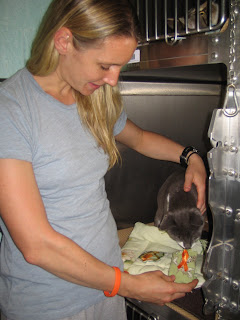

I like the social aspect of it- we talk about a lot of animal awareness and related issues while at the sewing and fabric tables. We share funny stories about our dogs and cats, and it's also a great way to meet potential volunteers for our other media and outreach projects. In addition, Patti Gilstrap, co-owner of Flirt, has been amazing in hosting the monthly event and helping everyone with the sewing machines. We would never have had nearly the success we've had if it wasn't for Flirt and the owners there.

Visits to the Brooklyn AC&C to deliver the beds is the best part of this project. I have cats but love all animals, so I welcome the chance to interact with the dogs, in addition to cats. When I see dogs with scars on their face, head, body, and I can tell it is from dog fighting, I am reminded that this form of animal cruelty is still very much a reality and must be stopped...and then it just amazes the heck out of me that they are also the sweetest animals, full of vitality and personality. It is not what most people expect but that's the reality. Dogs are truly amazing animals!

I also know that many of the dogs and cats we meet will get a chance at a better life in a new home with a new family. Some cage signs will have "Adopted" printed on them, so going to the shelter and seeing that is really rewarding since so many of us and others in rescue and awareness work so hard to educate people on shelter and rescued animals and that adoption is the only option.

So in summary, the bed delivery gives us a chance to see the reality of the homeless animal population first hand and to also see that the animals for adoption at the AC&C shelters are beautiful, wonderful companions that would thrive in a person's home. I take that with me, use these personal experiences in conversation with others whenever I can.


One specific anecdote would be wonderful. For example, did you develop special bonds with any of the animals you brought beds to?

When Susan and I went a few months ago, we saw a chicken. He was in one of the cages (a different room from the dogs, cats) and looked like he was in rough shape, pretty sad. We gave him a bed, though. I have always loved farm animals as well as cats and dogs, so I was glad to have an opportunity to show a little love to one. All animals should be treated well, taken care of, including farm animals, of course.


Some volunteers also feel compelled to adopt after they see the animals. Has that happened to you as well?

Not really -- I know I have a full house, and my main focus is on the public, people who want a pet and may not know much about adoption, where to go, or may be susceptible to going into a puppy/kitten shop. Some day I'll have a house and a big yard, and then I will definitely adopt a big dog!We take many pictures every time we go and we can share them with people via the website or other online mediums. I think it helps for the public, including our friends and family, to see pictures of people just like them interacting with animals in a shelter, especially larger dogs which may seem intimidating to some people at first. I think photos like this can help shift one's image of a city shelter, which is certainly part of what we do.


Finally, why do you think TONY readers should care and get involved, perhaps donating their time to delivering beds or their own sewing skills to the project?


There is no other project like this around NYC -- draws on people's creativity and compassion for animals. Plus each bed is made by an individual -- so it's like a gift from you, if you were to participate, to a shelter animal. It's very personal, and we always take tons of pictures so everyone can see how their work is directly helping animals -- and people. The beds are a great contribution to the staff and volunteers at AC&C. They can wash and reuse the beds, and they do not have the budget to purchase such durable quality beds for the animals. They are very grateful and express it every time we're there.
---------

Friday, May 22, 2009

More BSL conversations...

Breed specific legislation...continues in body of law and mind.

Earlier today, I called the Toledo Animal Shelter. I have been trying to reach them to inquire about pit bulls. I have noticed they never have any up for adoption. Finally, I got someone on the phone, and she explained to me that their insurance will not allow them to house pit bulls in their facility. The insurance company views them as vicious. I didn't get the name of the insurance as I was transferred to the Lucas County Dog Warden, but I'm sure whatever it was, it's not the only company that insures shelters therefore determines a lot of their rules.

So, I talked with a woman at the Lucas County Dog Warden, a department of Lucas County, of the state of Ohio. I grew up here (Toledo, OH), and I know that the city, even the entire state is not progressive in the animal awareness and rescue realm. I would say that I had a great conversation with Tom Skeldon, Toledo's Dog Warden. And the more I hear the pro-BSL side of the debate, the more I learn about how so many dogs, mainly pit/pit mixes, are exploited, abused, and ultimately discriminated against, and at the expense of their lives.

I also know that Skeldon is skilled at speaking to people like me, who are advocates for breeds such as pit bulls, which are often sentenced to death simply for being "at large", as Skeldon puts it. That is a municipal-ish word for stray. Skeldon has convinced members of the public that pit advocates are 'cults of personality' who have little backing. Skeldon wields power only because his father, Ned Skeldon, after whom Toledo Mud Hens field was once named, gave him a job. He knows Toledo, and he knows how to talk back to those challenging him on his anti-dog views. He need not speak truthfully, only convincingly.

In Toledo, pit bulls have been made out to be a public enemy, not because of pit bulls but because of cruel animal abusers. People like Skeldon convince the ignorant public that the dogs are the enemy simply by nature. Toledo remains ignorant.

Because someone lets loose a pit, rendering it homeless and out on the street to fend for himself, the dog is then sentenced to death if not claimed by the rightful owner. Now, unlike NYC, a rescue group may not pull the pit bull from the city shelter, and find a foster and eventually new home for the dog. Like Toledo Animal Shelter's insurance company, Skeldon, the city of Toledo, have a policy that all pit bulls must be put down if not claimed, and they may not leave the shelter except with their proven owner or in a body bag.


---

While I am writing the article on BSL in public housing here in New York City, I am concerned for other communities as well, where the rescue movement and pit bull, rottie, etc. advocacy initiatives are weak, compared to those in New York. Toledo is an example of a city where animal rescue groups advocating for pit rescue are categorized by ignorant people who hold on to this notion that all pits are bred and born to savagely rip apart people and small animals.

Although he did tell me on the phone that "PETA is in my camp. They are in favor of a ban, because they say that pit bulls are among the most abused animals in this country". When I asked, he agreed that pit bulls were the most "abused" breed of dogs. Somehow, though, he was not making the connection between the abuse and the way a dangerous pit bull behaves. PETA stands firmly behind mandatory spay/policies, and they also agree that bans on pit bulls can prevent an enormous amount of suffering (read full stance here). Those words never entered the conversation with Skeldon, only that pit bulls are dangerous.

Instead of going after the abusers, who Skeldon has admitted exist, he goes after the dogs in an attempt to rectify the "dangerous dog" problem. I think there is a dangerous PEOPLE problem, and I know I'm preaching to the choir here...

Tom Skeldon also pointed out that a woman named Bonnie Yoho, a pit rescuer, who took many of these types of dogs to supposed homes, was caught for dog fighting last year. A set back for pit advocates, but I have yet to find more than this from the Cleveland library, substantiating this claim. I'll keep looking...

To the main stream media, he implies something that anti-BSL individuals like me think is a ridiculous stance. Skeldon has been quoted as saying, "[The owners] all think that these pit bulls are nice sweet animals, but by the time they get to be a year and half or two years old, they're pretty intent on what they're bred to do and that’s grab a hold of things and shake it until it's dead." That is ignorance, sorry Skeldy. I wish he could meet Tilly, Stella, Gordy, and the dozens of other pits I know who are amazingly sweet and do not have a vicious or fighting bone in their body.

No pit bull these days are born knowing how to "shake" anything or fight -- people who aim to use them as weapons, these loyal dogs that are hardwired to please their owners no matter how much pain and anguish they suffer, are at fault. Why is there not animal exploiter-specific legislation? My theory is that dogs are EASY to control. Drug dealers with illegal hand guns are not. Skeldon has an easy job and he can easily catch and euthanize pit bulls to fulfill his duties.

In my interviews, conducted in two NYCHA housing projects on Tuesday and Wednesday, I was told that the people who engage in formal dog fighting are the same people dealing drugs and keeping illegal guns. If police tried harder to crack down on dog fighting, who is to say they would not inevitably crack (no pun intended) on drug dealers? Again, people with pit bulls are easy targets. Dog fighters behind closed doors are harder to find, and they are much more dangerous people in the community. Make a new policy banning pit bulls -- looks like the authorities are taking action to protect the people. But that is where the action ends. Enforcement of even the existing laws in public housing, such as mandatory spay/neuter, registration and $25 fee, and dogs on leash at all times -- ALL TIMES, even in fenced in grass areas in the courtyards of some of these housing squares -- are not enforced heavily enough, according to residents I spoke with.

Gladys, who has had Dream, a 7 yr old pit, since Dream was four months old and her niece was trying to find a home for her, has concured that there is also a problem with people not picking up after their dogs and also allowing them to relieve themselves in the elevators and hallways of their buildings. She has lived in public housing for 38 years and complains of lack of enforcement on drug dealers in her building. She said these are the same people who are responsible for the vicious dogs people are afraid of and that if people did not mistreat pits, such as those like Dream, they would not harm people and have the reputation they do. She took Dream in because she said she feared the pup would end up in the wrong hands.

Samuel, resident of East Rivers housing at 100th and East End has had pit bulls and rottweilers in the past, two of the three breeds now banned in public housing. He said that these dogs can become a weapon if in the wrong hands, just like a gun can be in the hands of a corrupt cop. He says that he knows of incidences where drug dealers harbor dogs who they have trained through cruelty and fear tactics to be weapons, and they have thrown their dog(s) at the cops when they enter the house to attack them, while they try to flee. In instances I personally have heard of, dogs have been shot and killed by the police, purely as a means to protect the police persons' lives.

Will banning pits, rotties, and dobermans (who I have not seen at all, on the sidwalk or in dog parks, anywhere, in over three years) in the projects stop the criminals from using these animals as weapons? Will it stop crimes such as dog fighting rings? which not only violate animal cruelty laws but also organized gambling laws. Will it stop people from breeding pits in the public housing projects?

This debate, as far as whether or not laws focused on animals, not peoplem, will go on for a very long time, but it is essential that everyone who cares about the issue listen to both sides. That pits are the most abused and exploited dogs in America cannot be debated -- it is a consensus among all parties of all opinions. It is sad and in the end the dogs suffer the most, and people are left to walk the streets, having abused and killed dogs only for money.


My article on the policy won't be as subjective as the above. I look forward to getting printed the statements from many different people from all sides of the topic, including rescuers who are in favor of the ban.

Please spread the word if you know a pit bull and his/her owner who are heroes and ambassadors for the breed. Same goes for Rottweilers!!

Below is Rational Animal's pit bull ambassador, Sadie Blackstar, who's mother, Susan Brandt, is the Director and Founder of Rational Animal. Sadie is an amazing creature. Despite the scars on her body and legs, she remains cool and sweet around other dogs and people.


My phone call with Tom Skeldon ended when he told me that he had just been called out to go tranquilize a pit bull. Snide and immature, but what do you expect?

Thursday, May 14, 2009

Pet-so-heartless...Petsmart profits off animal cruelty

Pet-so-Heartless:
Petsmart profits off animal cruelty
OK here's another one to put on your DNS list (do not support :-). http://www.petsmartcruelty.com/

Don't support Petsmart!! They make money off animal cruelty every day and also propagate the small animal and bird trade, which is more or less on same plane as the puppy mill industry, as far as the factory-like conditions and inadequate care and transportation systems. Not many people realize this!


Check this photo gallery to find out what happened to this poor rat and read stories and see documentation of individual cruelty cases PETA uncovered.
These animals are absolutely helpless and the public that purchases Petsmart products is clueless!!

While Petsmart may not be involved in the terribly, utterly cruel puppy and kitten mill industry, like chain stores such as Petland and Brooklyn's Pets Unlimited are, they too contribute to a mill-like industry -- one involving birds and small animals such as rabbits, gerbils, rats, and hamsters.

HERE'S WHAT TO DO: Shop at small, honest neighborhood pet supplies stores that do not sell animals or any living beings at all!

Did you know that you can adopt a rabbit, a gerbil, a hamster, a bird, even a snake?

In New York City, check out
Sean Casey Animal Rescue in Brooklyn, who have an adoption facility and pet supplies shop:
THE HAMILTON DOG HOUSE
155 E. 3rd St., Brooklyn, New York
Between Caton and Ft. Hamilton
718-436-PETS

... and Social Tees in Manhattan's East Village (owner Robert, pictured here), who have also have an adoption facility and pet supplies shop:
SOCIAL TEES ANIMAL RESCUE
124 East 4th St.
New York, NY 10003
1-800-200-7338

Elsewhere, check petfinder.com and also explore your local rescue groups to help connect you to the wonderful people in your community or close by that help rescue these animals -- which often go unnoticed in the campaign to end homelessness and euthanization of animals across america.


Check out these to learn more about small animal adoption:
Metropolitan Guinea Pig Rescue
http://www.mgpr.org/
House Rabbit Society
http://www.rabbitsinthehouse.org/

And before you decide to bring a small animal into your home, do your homework!! It's very important that you commit to protecting and caring for any animal in your home for their entire lifetime.

Tuesday, May 5, 2009

Kitten Mills...what you may not know!

Most of us know about puppy mills...but...cats and kittens suffer from these cruel practices as well. Please don't forget about the millions of cats that suffer at the hands of cruel people every day.If you care about the puppies and their breeder moms, you should be inclined to care about and help spread awareness of the kittens and cats that are abused in the same way puppies and dogs at puppy mills are.
The best way to show you care is to adopt -- never buy from ANY breeder -- and encourage others to do the same.
Please PLEASE always adopt. I have rescued cats, and my life is forever enriched because of them.
http://www.petfinder.com/
If you use facebook, please join this Group page: http://www.facebook.com/group.php?gid=2231723482#/group.php?gid=59671486684&ref=mf
Here you will find more hard facts and information about the feline side of breeding mills. The bottom line is that the best way to stop this cruelty is to not support it. Over the years, we have seen increasing numbers of mill busts by groups like the Humane Society of the United States, Rescue Ink, and Companion Animal Protection Society. But there are tens of thousands of these mills across the country and in other countries as well, including suburban areas in Canada, where mills churn out puppies and kittens (and rabbits, for some) to be sold not only in Canada but in the United States as well. Because there is still demand, stores that sell animals, particularly puppies and kittens, are making significant profit off animal cruelty. The aforementioned groups are making significant inroads on combatting this problem, but it's a huge industry and we need more people to be educated and take actions on their confictions that animal cruelty is wrong and should NOT be tolerated anywhere.
If you want to take your stance against animal cruelty one step further, don't buy ANY products from stores that sell these animals. I recommend buying your pet food and supplies at smaller boutique and neighborhood stores that tend to carry the higher quality food, such as Wellness, Weruva, Blue Buffalo, and Halo, to name a few. I personally would prefer people make the choice to buy their pet good from these smaller stores that do not sell any living beings of any type -- not bird, gerbels, or even fish.
Remember -- you can empower yourself and reaffirm your stance against animal cruelty by making informed choices and not giving money to any business that exploits animals. It's up to you!
For more information about the kitten/cat mill industry and how you can help, see below:

What can you do to help?
1) NEVER BUY A CAT OR KITTEN FROM A BREEDER. Always adopt from your local shelter or rescue organization. Find the perfect cat or kitten in your area here: http://www.petfinder.com/.
2) BECOME INVOLVED WITH A CAT RESCUE ORGANIZATION. These organizations save lives every day by rescuing unwanted cats and kittens from local shelters and helping to find them homes. Many also provide low or no-cost spay and neuter services that help curb feral cat populations without killing. This is some of the most important work that can be done.
Join Stray Cat Alliance.
WEB http://www.straycatalliance.org/
FACEBOOK http://www.facebook.com/group.php?gid=59671486684#/group.php?gid=38783974284&ref=ts
Join Alley Cat Allies
WEB http://www.alleycat.org/NetCommunity/Page.aspx?pid=191
FACEBOOK http://www.facebook.com/pages/Alley-Cat-Allies/37899252087?sid=66d31e438b18fb0697fa04d1d967c75c&ref=s
Join Kitten Rescue
WEB http://www.kittenrescue.org/home.php
FACEBOOK http://www.facebook.com/pages/Kitten-Rescue/115219435429?sid=b9e79643375723ef5ce0161bde38a1e5&ref=s
PLEASE DONATE YOUR TIME OR MONEY TO AN CAT (OR DOG) RESCUE / AWARENESS GROUP.
Your help is desperately needed, and every little bit helps.
In New York City, please go to http://www.animalalliancenyc.org/ to find a group in your neighborhood or that you're interested in volunteering for or donating to.

Contact ckistler@rational-animal.org to find out how to get involved with our awareness campaigns aimed at shutting down breeding mills and fighting other cruelty issues, including educating the public and engaging people to be active in supporting kindness to animals and efforts to lower homeless animal populations.

Thursday, April 30, 2009

Senate Bill (S. 727) to Ban Horse Slaughter Introduced

Senate Bill (S. 727) to Ban Horse Slaughter Introduced

THE DEAL
Recently, a bill to ban horse slaughter was introduced in the United States Senate by Senator Mary Landrieu (D-LA) and Senator John Ensign (R-NV). The Landrieu-Ensign "Prevention of Equine Cruelty Act" (S. 727) will end the slaughter of American horses here and abroad. In 2002, legislation was first introduced to protect horses from slaughter. Recieving strong bipartisan support, the bill made horse slaughter and associated activities illegal and included both civil and criminal penalties. A subsequent version of the bill passed in the House by a landslide vote in 2007. This 2009 Act would amend Title 18 of the US Code and give law enforcement more tools and resources to ensure all horses are protected from the cruelty of slaughter. The law will be uniform across the US and enforced by professionals trained in upholding federal law.
------
THE REALITY
Some of the horses at the slaughter auctions and then the actual facilities where the slaughter is carried out are ex-carriage horses. The horses you see in Central Park, in Columbus Circle, and maybe even on the West side near Javits Center, are often sold for money at horse auctions from which they are then transported, sometimes for 24 hours without food, water, or a chance to walk outside, in large cramped trailers with all the other horses who have been sentenced to death; they are unloaded at the slaughter house quarters, they wait, then they are, one by one, shoved into a metal confinement and are shot with a bolt gun (like a nail gun but bigger and more powerful) in the head. This is the typical scenario, and I emphasize typical, because I don't know what happens at every single slaughter house. Some may be better than others, and some, may be worse and crueler than the following:
These bolt guns are controlled by one person who does this same job all day and operated by a longer mechanical arm, rendering the device unwieldy and inprecise. The executioners often miss the spot on the horse's head where they are supposed to shoot the nail to render it unconscious. Thus, the horse endures numerous attempts before collapsing. One side of the confinement opens, and the horse is then strung up with a thick rope by one hind leg, attached to a suspended conveyer. The live horse is moved to an area where more men reside most of the day to carry out the job of slicing open each horse's throat. Their job is to slit the jugular, but, certainly they don't always hit the small, precise spot on each individual horse where the center of the jugular is supposed to be. Hopefully the men slit the jugular to hasten to dying process. When the horse seems dead, it is dismembered and chopped for meat. Eventually humans consume the horse.
-----
POINT / COUNTERPOINT

Not everyone agrees with a BAN on horse slaughter -- a level higher than these previous protection laws. A friend of mine who lives in the LA area supports the ban and posted this information and a link to a website with expanded details to her Facebook page. She recieved some responses that I wanted to share, including my own take.

Author post: http://capwiz.com/compassionindex/issues/alert/?alertid=13041801


Response 1: Banning horse slaughter is not the answer. Educating the public about horse ownership and lifetime expense, and reopening supervised slaughter facilities is the answer.http://www.avma.org/issues/animal_welfare/unwanted_horses_faq.asp


Author's Rebuttal: Why not do both? These issues won't be solved on one front alone. They need to be addressed from every angle. There is no one right "answer" as far as this is concerned. What is wrong with banning horse slaughter while we educate the public?


Response 2: We'd need ~2700 new rescue facilities per year to deal with the current number of unwanted horses. We must reopen slaughter facilities until we can get the horse population under control. The cost of hay has been through the roof the past year and many people are allowing their horses to starve because they can't pay for food. Many also can’t afford euthanasia or burial expenses. (usually about $300-400) Small animals can go to a shelter and hopefully be adopted out or meet a peaceful death with barbiturates. This is rarely the case with horses. It just isn't nearly as feasible to open enough shelters for horses as we have for small animals. What you’re saying is tantamount to saying that we should close all small animal shelter before educating the public on spay/neutering and rescue.


Author's Rebuttal 2: Yes, I did read the entire link. Clearly, you don't expect me to read a link and simply accept it as fact? I could send you links all day to the contrary, so it isn't about reading or not reading the link.


CK: Perhaps it is necessary to look at why horses go unwanted. If there are initiatives to provide slaughter houses and those which are back by so-called humane advocates, then people will be more apt to discard the animal rather than plan for long-term care and, if necessary down the road, plan for an alternative to slaughter. In addition, when the when the opportunities to make profit at slaughter houses dwindle, this will also add to a general impetus to direct attention to sanctuaries rather than meat auctions. IT would also lower demand of horses for any purpose. The above will have a trickle-down effect, in a the way of education, as people will begin to view horses, animals in general, as beings to be respected not property to be discarded at a point that any given human declares it to be. The same concept applies to small domestic animals, and the debate is similar to that between people like and organizations like PETA who advocate for euthanization over rehabilitation.In addition, we'd probably need 27,000 new rescue facilities per year to deal with the current number of unwanted cats and dogs, rabbits, other. The reasons they are or go unwanted is at the crux of coming up with solutions and enforcing those solutions, such as spay/neuter, humane edu, and adoption. Shelters, sanctuaries need more resources and attention. The efforts for the above are generating positive results but it is a long-term effort, and simply killing all leftover animals that do not have homes is counterproductive. I’m for prevention, as I believe most people are. It’s just a matter of understanding the concepts that put such sentiments into action and effect the desired results.


Author's Response: CK, you so eloquently made these points that I won't try repeating them. I will also add that slaughtering the leftover horses is also done for financial gain, and this makes it even more wretched (and also distinct from the situation of domestic animals).

-----
If you would like, here is a real -- graphic yet real -- video of the process of horse slaughter: http://www.youtube.com/watch?v=wyF3IcIK2_A. I encourage everyone to please take a chance to view this. Without knowledge of the truth about the way humans treat animals, we cannot mobilize properly to stop it. If you are against cruelty, please watch this video of cruelty and affirm your convictions.

-----
If you agree with the ban, please take a moment contact your Senators and ask them to cosponsor this vital legislation.

For more information please contact AWI at:
Animal Welfare Institute
900 Pennsylvania Ave., SE
Washington, DC 20003
(202) 337-2332
http://www.awionline.org/

Friday, April 10, 2009

Letter to NY Times, in response to Nicholas Kristof's "Humanity Even for Nonhumans"

Any time an animal rights or welfare article comes out in a prominant publication like the New York Times or the Wall Street Journal...or Forbes (eh, rarely), I will usually find it on one of my friends' Facebook profiles, either as their status or as a Note with a few others' comments below it.

So yesterday I came across this one from the New York Times journalist, Nicholas Kristof: "Humanity Even for Nonhumans". He is well-respected and prolific, and I was very please to see him take up the topic of legislative protection of animals and the general animal rights issues this inevitably brings to the conversation. I took some issue with his interviewing Peter Singer, however, as Singer is not a lawyer, a legislator, or even a law professor. Singer is a philosopher and an ethics and philosophy professor at Princeton. Philosphy is grand, I do believe, but it is limiting as far as using various principals in every day life. When it comes to animal rights, philosphical beliefs that Singer subscribes to, most of which I do as well, come unraveled, however, at a certain point. What is left to do then? I assert then one analyzes law and focuses on the very things that Kristof began his piece with.
And hence...

-----------------------
From: Courtney Kistler <ckistler@rational-animal.org>
Date: Thu, Apr 9, 2009 at 5:36 PM
Subject: Letter, response to Humanity Even for Non-humans


In response to Nicholas Kristof's article today, "Humanity Even for Non-humans":

Thank you, Mr. Kristof, for paying some time and attention to this topic and noting that the rights of animals are indeed of greater importance to more people now than ever.

I thought it odd, however, that, though he referenced Bentham's assertion ‘...can they suffer?’ as principal for himself, Peter Singer said he was “unsure about shellfish”. I would assume he's aware of the practices of commercial fishing and the suffering that other animals, including mammals, endure as consequence.

But then again, this is why Philosophy is impractical and needs Law to bring it to life.

Your piece did not pay attention to the enforcement gap hindering the effectiveness of humane law in America. Because this exists, free-range farm workers may continue inhumane practices, unmonitored. This is very important in our deciding whether or not to eat produce from these places.

While I'm glad you wrote on the topic and cited the increase in protection of animals through legislation, I hope you will write a second piece and get the opinion of a law professor or legislator who knows about Prop 2 and has practiced in humane law. In a way, there is a point where Philosophy stops and Law takes over.

Next op-ed, Cass Sunstein?


Courtney Kistler
Rational Animal
New York, NY
(212) 933-1688 or (419) 261-0223

-----------

Numbers and stats supporting argument above re. commercial fishing practices:

Description of the actual fishing practice that continues to kill off marine life including sea mammals and endangered species like all six species of America's sea turtles: http://oceana.org/north-america/what-we-do/stop-dirty-fishing/about
Some factory farm / animal issues to read up on:
Battey-caged chickens: http://www.hsus.org/farm/camp/nbe
One of the best resources for like...everything: http://www.farmsanctuary.org/

Thursday, March 5, 2009

The Animal Rights Orgs' Undercover Investigations...and becoming an educated, informed consumer

People for the Ethical Treatment of animals conducted an undercover investigation at an Iowa Hormel pig factory farm.

From PETA.org: “For more than three months, PETA went undercover at an Iowa pig factory farm, which supplies piglets who are raised and killed for Hormel products. PETA found rampant cruelty to animals committed by workers and supervisors. The farm changed ownership and management during PETA's investigation, but that made no difference to the animals who were born and confined there: Abuse and neglect were widespread during PETA's entire investigation.”


PETA is one of the few organizations that actually monitors this closely the practices at factory farms. Lawmakers and legislators do not go in with their cameras to film what they are supposed to be regulating. This is raw video, this is not edited, so please be aware that much of this is very difficult to watch – yet this is reality. These are people in OUR country committing such brutal, cruel acts on animals. These people can be walking next to you outside, driving down the highway on the same mile as you, sitting next table over at a restaurant eating the very animals they bloodied, tortured, and in the case of dozens of piglets, beat to death just earlier that day.

I commend those at PETA who undertook this painful assignment. Very few are capable of carrying out filming something so horrific and disturbing. While you and I watch the video and hear the pig screaming for mercy as a farmer beats a pig on his back and stomach with a metal gate rod, a person with a camera is there witnessing it him or herself. Most, including myself, would be incapable of standing there and not trying to stop any of those men from abusing the animals. But in order for us to become educated, informed consumers, we need groups like PETA and the Humane Society of the United States, whose footage from puppy mills to animal testing labs has been aired on network TV, out there taking on these tasks of exposing animal abuse and then taking action on stopping it, as well as educating and informing we consumers about how we too can take action to stop it.

Although these videos are very difficult to watch, I would encourage everyone to watch for at least a couple seconds – because this is not a TV show or movie, this is real and these are people in our country committing such atrocities. I hope that fewer and fewer people turn a blind eye to this, because it reflects a part of our population that lacks sensitivity, that lacks compassion toward life in general, and that exemplify the cowardice in attacking a living being who is rendered helpless and defenseless.

The factory farm employees in this individual video represent hundreds, perhaps thousands, of others just like them who perhaps wouldn’t allow cameras in their factory farms.

Please understand that without large animal advocacy organizations with resources and finances to carry out these documentaries of abuse, we would not have the opportunities to learn the reality of an industry we have daily interaction with.

This
article conveys the other side. A writer for the Farm & Ranch Guide wrote about a Minnesota factory farm who was exposed for abuses, just as the one in Iowa was. Their employees committing atrocities against the animals on their farms was caught in real life, on camera.

You will read that through most of the article, the MowMar farm representatives are defensive: “We're here to demonstrate this can happen to you. All of us in the industry, and all sizes and types of operations, need to be prepared and try to prevent this type of action from happening...The amount of extra time and strain it has put on us, we really don't want anyone else to have to go through."
On the experience: “It was a coordinated effort of many industry partners…makes things go smoother and quicker, and easier to defend…I think we did pretty good, but we could have been more prepared.”
The reporter finally said that it is very important that applications are completed and that the farming employer conducts a background check.That this needs to be reiterated in the context of an article like this is appalling. Furniture companies do background checks, my dad’s dealership conducts background checks. Shouldn’t that go without saying for a company who relies on individuals’ proper handling of live animals in order to profit?

You will also read toward the end an admission that proper regulations, employee screening processes and training, as well as management consistently monitoring their businesses on the ground is lacking. The only victims are the animals, as each of these farms continues to employee people and make money. If their only motivation to treat animals humanely is so they don’t have a PR crisis on their hands, then I’ll take that. It’s not the reason I’d prefer, but if animals’ lives are in better care, then I would call PETA’s actions successful. Their aim is to expose the abuse not change things overnight or solve the problem in one day or with one sole investigation.
Lastly, the only way to help stop these atrocities is to not support the business. Go veg. Click here to read about all the reasons why it’s better for you, for the environment, for all living beings with whom we share Earth.

If you do not add to the demand, Hormel and other meat-producing corporations will not have means to keep producing the supply. And as demand for vegetarian products rise, farmers will shift toward cultivating these products, away from the slaughtering of animals.